
Weber Shandwick is working with South Africa Tourism to promote travel to Cape Town, which has been in the news as potentially the first major city in the world to run out of water.
|
|
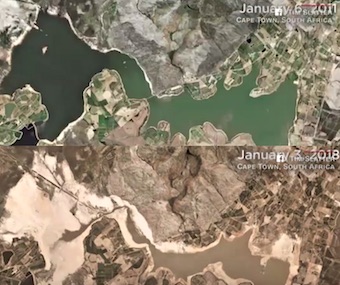 Aerial view of Cape Town comparison between 2011 (top) and 2018.
The Interpublic unit began work Feb. 14., handling media requests, pitching reporters and developing messages to best position Cape Town and South Africa as tourist destinations.
The budget for fees/expenses is capped at $100K.
The Guardian (Feb. 3) reported that Cape Town is in the midst of a one-in-384-year drought.
Greg Pillay, a Cape Town emergency services official, identified water shortages, sanitation failures, disease outbreaks and anarchy as the major risks faced by the city.
Unless water consumption is drastically slashed, the city forecasts July 9 as Day Zero, when reservoirs fall to 13 percent of capacity, and water valves to one million homes, 75 percent of the city, will close.
Residents will then have to go to 200 municipal sites, where armed guards will enforce the daily intake of water to 6.6 gallons.

 There’s a fine line between newsjacking and taking advantage, aka ambulance chasing. Our job as PR professionals is to tread it carefully.
 PR firms need to be mindful of ways their work product may be protected by the attorney-client privilege whenever working with a client’s internal legal team or its external legal counsel.
 Manuel Rocha, former US ambassador and intenational business advisor to LLYC, plans to plead guilty to charges that he was a secret agent for Cuba.
 CEO mentoring is an often-overlooked aspect of why CEOs are able to make good decisions, and sometimes make bad ones—all of which intersects with the role and duties of a board.
  How organizations can anticipate, prepare and respond to crises in an increasingly complex world where a convergent landscape of global challenges, threats and risks seem to arrive at an unrelenting pace.

 Have a comment? Send it to
No comments have been submitted for this story yet.