
Reclusive hedge fund billionaire Eddie Lambert, who engineered the 2005 merger of Sears and Kmart which led to the loss of thousands of jobs and stores, talked to the April Vanity Fair magazine.
He was accompanied by two representatives from Teneo Holdings, the high-stakes corporate advisory and communications outfit, who monitored the conversation.
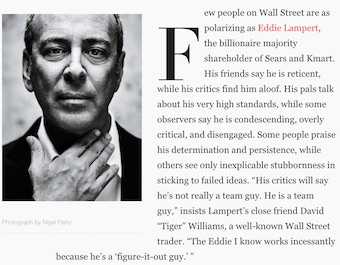 |
The profile is headlined “The Devil to Pay.”
A Teneo rep told writer William Cohan that Lambert hadn’t conducted a “one-on-one first-person interview for several years.”
Cohan calculated that Lambert hasn’t talked to the press in 15 years, a low-profile that may be do with his kidnapping in 2003 and being held for ransom.
Lambert’s “blundering into retail has made him a poster boy for what some people think is wrong on Wall Street and, in particular, hedge funds,” wrote Cohan.
Sears and Kmart, which combined for 5,670 stores at their peak in the 2000s, now have 1,207 outlets and 200,000 fewer workers.
Last year, Sears Holdings admitted that its future as “a going concern” is in doubt, an accounting term that often serves as a precursor to Chapter XI.
Cohan wrote: “The vultures are circling, waiting for Lambert to throw in the towel so they can try to make money by buying Sears’s discounting debt.”
The Teneo rep responded: “There is no merit to the speculation that Mr. Lambert is working to benefit from the ‘liquidation,’ ‘failure’ or ‘bankruptcy’ of Sears Holdings.”
For his part, Lambert said: “We’re fighting to survive—that’s pretty clear,” and, “I believe in what’s possible, and we’re doing things that are necessary to keep the company going.”
 It's almost always possible to recover from past mistakes, but the way the Met handled the John Galliano fiasco is an object lesson in how not to do that.
 How to reach audiences who have stopped trusting the biggest names in media.
 It's not just the tech sector—when companies in any sector grow rapidly, what happens to their ability to manage, learn from and prevent critical issues from evolving into full-blown crises?
 FGS Global’s Paul Holmes, Molly Levinson of TLG Communications. Trident GMG’s Joshua Galper and Brunswick Group’s Ellen Moskowitz all placed in the top level (Tier 1) of individual practitioners in the recently released Chambers rankings for both crisis & PR communications pros and those working in litigation PR & communications.
 Gregg Feistman, M.A., Professor of Practice in Public Relations at Temple University and former corporate communications executive, joins Taking the Lead to discuss the frameworks leaders can use to determine when to speak up or stay silent.


