
Live video streaming continues to gain adoption worldwide, with consumers viewing more content more often from an increasingly diverse array of sources and devices, according to a global survey of consumer live video streaming preferences by ad organization the Interactive Advertising Bureau.
Nearly half (47 percent) of consumers worldwide who watch live streaming video said they’re viewing more of this content today than they were a year ago, according to the IAB survey. In total, more than two-thirds (67 percent) said they’ve streamed live video content, and 70 percent of those viewers said they now engage in the activity at least twice a day.
Smartphones are now the most frequently-used device to live stream video content, cited by 62 percent of respondents, followed by smart TVs.
There’s little question that all this streaming activity is coming at a cost to traditional TV consumption. Nearly half (44 percent) of consumers said they now watch less live TV as a result of the new streaming options available to them.
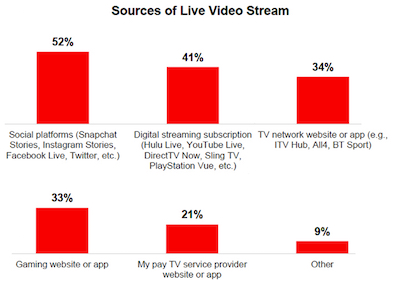 Which of the following sources do you live stream video content from? |
Where are consumers watching this content? More than half (52 percent) of viewers said their preferred source of live video is found on social platforms like Snapchat, Instagram, Facebook and Twitter, compared to digital streaming subscription like Hulu or Netflix (41 percent), a TV network website or app (34 percent), a gaming site or app (33 percent) or a pay-TV service provider (21 percent).
The U.S. appears to buck the trend somewhat in this regard. American viewers appear more likely to watch live video through a digital streaming subscription service than their worldwide counterparts (43 percent versus 41 percent). Globally, viewers are more likely to stream live video by other means (social platforms, a TV network site or app, a gaming site or a pay-TV service provider).
When it comes to the factors influencing users’ streaming video source of choice, 45 percent said quality content makes that determination, followed by the speed of an available Internet connection (38 percent) and whether that service is free or requires a subscription (35 percent).
More than half of consumers who stream live video content (52 percent) said they prefer free, ad-supported live streaming as opposed to subscription or à la carte services. About a third of respondents said they now pay for TV or subscription video services.
Respondents said TV shows are the most preferred type of content to stream, followed by sports, tutorials, gaming and news.
IAB’s “Live Video Streaming: A Global Perspective” survey was conducted in May by mobile market research company OnDevice Research in 21 markets around the world.

 Trump Media & Technology Group today reported a $58.2M net loss on $4.1M in 2023 revenues, a disclosure that drove its stock price down 22.6 percent to $47.96.
 Barry Pollack, an attorney at Wall Street’s Harris St. Laurent & Wechsler, has registered Julian Assange as a client with the Justice Dept. “out of an abundance of caution.”
 Paramount Global to slash 800 jobs in what chief executive Bob Bakish calls part of an effort to “return the company to earnings growth"... Rolling Stone editor-in-chief Noah Shachtman is exiting at the end of the month due to disagreements with chief executive Gus Wenner over the direction the magazine is taking... The New York Times broke the $1 billion barrier in annual revenue from digital subscriptions in 2023... Press Forward is investing more than $500 million to strengthen local newsrooms.
 The majority of news articles are read within the first three days of publication, according to a recent report.
 The Los Angeles Times gives pink slips to 115 people or 20 percent of its newsroom staff... TIME is also laying off about 30 employees, which is approximately 15 percent of its editorial staff... The Baltimore Banner, which was launched by Stewart Bainum in 2022 after he failed to buy the Baltimore Sun, added 500 subscribers per day in the three days following Sinclair Broadcast Group's deal to purchase the Sun.


 Have a comment? Send it to
No comments have been submitted for this story yet.