
 Ken Scudder |
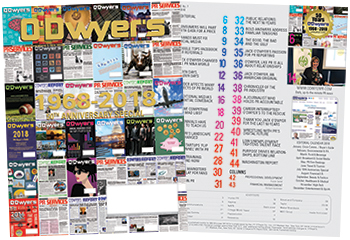
I’m using the occasion of O’Dwyer’s 50th anniversary to reflect on my own career, and how I’ve seen media training change in the approximately 25 years I’ve been conducting it.
The most obvious, and least important, changes involve the basic technology involved in the training. Twenty-five years ago, my clients left the training day with a video cassette containing all of their simulated interviews and presentations. Today, I email the mp4 files or hand over a memory card. Instead of faxes, I confirm trainings and get background via email. Instead of a quarterly newsletter, I post on my blog. And, blissfully, the cameras I now use are much smaller and easier to bring on the road.
|
|
More significantly, the media available to my clients has increased exponentially. Calling the increase in news outlets, and “news” outlets, an “explosion” grossly understates it. This hasn’t been an “explosion,” it’s been a “big bang.” There are more opportunities for newsmakers to get their stories out than at any time in history. There are also more opportunities for making a devastating error.
And those devastating errors are ending careers faster than ever. There is no such thing as a small, local mistake anymore. The pressure to “get it right” in every public encounter is excruciating. And, as we saw in the last two Presidential campaigns, private events are no longer truly private.
Because of this, I’ve put a premium on crisis prevention in my media training sessions. The increased difficulty in recovering from a slip has moved me to focus even more on ensuring the answers to the toughest questions are nailed down, defensible, and truly satisfy those questions. It has also led me to spend more time reviewing what pitfalls exist, as a slip is more likely to occur when the question is unexpected instead of one we prepared for. And, I’ve told all my clients to assume that there is someone attending every public appearance of theirs who disagrees with them 100 percent and is recording everything they say in the hopes of sending their error or inflammatory statement out into the world.
To me, one of the most interesting changes is where TV interviews are taking place. When we founded Virgil Scudder & Associates in 1990, we wanted a TV studio that looked like a “TV studio”: overhead lights, large cameras on tripods, big monitor and an “On Air” sign. Today, outside the network morning shows, most TV interviews look like they’re happening in a coffee shop with WiFi. Also, the number of interviews that are taking place via Skype or other video chat apps has had me adjust my training to include more “one shot” simulations (looking directly at the camera) and remote interviews.
The change I’m shocked by — and one that has only come into play in the last two years — is the fact that I now feel the need to tell my clients their answers must be true. Not that I feel that my clients have been lying; on the contrary, I’m proud of the honesty of the men and women I’ve worked with and for. But there are now so many examples of pure, unbridled dishonesty in the public discourse that I fear many people will take this as an example of “how to do it.”
For decades, I’ve taught that you satisfy any tough question you get, and then steer to one of your key points. I’ve always taught that those points must be “interesting and relevant to the topic of the interview.” Until recently, I never believed I would have to tell people they also must be honest.
No matter what advantage a public speaker seems to enjoy for dishonestly, I still firmly believe that it’s only short-lived. Presidents Richard Nixon and Bill Clinton will forever be known as liars, and I have no doubt the current inhabitant of 1600 Pennsylvania Avenue will as well. I also believe strongly that anyone caught lying has more trouble getting what he/she wants accomplished despite a short-term gain. For example, in mid-June, Department of Homeland Security Secretary Kirstjen Nielsen tweeted that the administration does “not have a policy of separating families at the border. Period.” However, Attorney General Sessions and the President himself have confirmed, and even bragged, that they’re pursuing such a policy. This fabrication will not only hurt Sec. Nielsen’s career, it also will prevent people inside and outside of her department from acting on anything she wants done as her public persona is now damaged.
The last change I’ll discuss is the growing distrust in the media. From day one, I’ve had some clients say “it doesn’t matter what I say in an interview, the reporter will just write what he or she wants.” And I’ve countered that while a few reporters may not be as fair as you’d like, you can succeed with almost any reporter if you make your points and handle the negatives. Over the past ten years, however, the number of clients who come in with the aforementioned attitude has multiplied. I’ve been working harder to show examples of how newsmakers have handled hostile interviews, and how they can “win” no matter what the interviewer’s perceived bias.
Regardless of technological and societal changes, one thing has remained constant: the need for clear, concise, and consistent messaging. This proliferation of outlets, and thus overall news content, makes consistent messaging even more critical. And as the number of viewers/readers/listeners for each source diminishes, newsmakers must focus even more on delivering the same message across multiple platforms. What you say on MSNBC should be nearly identical to what you say on Fox, to the New York Times and the Orange County Register, and across your Tweets, Facebook posts, and whatever social media channel has sprung up in the 30 seconds it took me to type this sentence.
I’m excited about where the news media, public relations, and the communications training field are going in the next 25 years. And I’m comforted by the thought that O’Dwyer’s will continue to report on it all for the next 25 years, 50 years, and beyond. Congratulations to Jack, John and the entire team!
***
Ken Scudder has provided media training, presentation training, crisis communications training and consulting, and writing and editing to business leaders, celebrities, and politicians for more than 20 years.

 Publicis Groupe CEO Arthur Sadoun puts competition on notice... Macy's throws in the towel as it appoints two directors nominated by its unwanted suitor... The Profile in Wimpery Award goes to the Ford Presidential Foundation for stiffing American hero and former Wyoming Congresswoman Liz Cheney.
 JPMorgan Chase chief Jamie Dimon's "letter to shareholders" is a must-read for PR people and others interested in fixing America and living up to its potential... Get ready for the PPE shortage when the next pandemic hits... Nixing Netanyahu. Gaza carnage turns US opinion against Israel's prime minister.
 Trump Media & Technology Group sees Elon Musk's X as an option for those who want the free expression promised by Truth Social but without Donald Trump, owner of 57.3 percent of TMTG... Chalk one up for "anti-woke warrior" governor Greg Abbott as University of Texas lays off 60 DEI-related staffers... Five percent of Americans see the US as its own worst enemy, according to Gallup.
 Nine of the Top 100 firms that participated in O'Dwyer's rankings last year apparently threw in the towel for the 2024 scorecard. Seven other firms also went AWOL.
 The silence of the White House enables Israel's crackdown on foreign media as it objects to coverage of the carnage in Gaza... Israel plans yet another probe. Promises investigation of its "unintentional" attack on workers delivering food to famine-sticken Gaza... Trump White House media star Hope Hicks to return to spotlight.


 Have a comment? Send it to
No comments have been submitted for this story yet.