
 |
Major Internet companies aren’t doing enough to identify and stop the spread of fake news that appears on their platforms, according to a recent survey by the Knight Foundation and opinion poll giant Gallup.
According to the survey, which was based on a series of reports that gauged Americans’ views on the role major Internet companies play in delivering the news, 85 percent of Americans don’t think sites like Facebook, Google and Twitter are doing enough to stop the spread of misinformation.
More than two-thirds of U.S. adults surveyed (69 percent) also believe Internet companies are limiting Americans’ exposure to viewpoints different from their own. A majority (54 percent) said they dislike digital publishers’ habit of tailoring items to individuals based on their interests or Internet search history. In fact, 57 percent said they believe major websites’ tendency to exclude certain stories based on a user’s past activity constituted “a major problem” for our democracy. Instead, nearly three-quarters (73 percent) said they’d prefer a system in which all users were shown the same content.
An overwhelming majority (88 percent) said they want these publishers to publicly disclose what methods they use for targeting news items to Internet users.
|
|
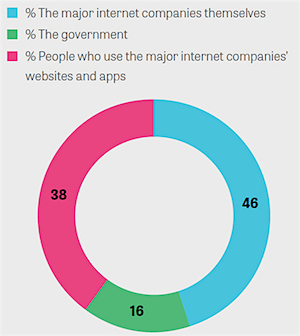
So, who should bear the burden of ensuring that the information that circulates over the Internet is accurate and unbiased? Most (46 percent) said that obligation falls on the shoulders of Internet companies, compared to 38 percent who said the responsibility belongs to Internet users and 16 percent who believe government agencies should step in and do it.
And while a relatively small minority of Americans believe government should be primarily responsible for making sure Internet companies are delivering reliable content, nearly eight in 10 (79 percent) believe tech companies should be regulated like “traditional” media organizations such as newspapers and television news stations.
The Gallup/Knight Foundation survey comes on the heels of a new report published by Canadian journalist Edward Greenspon and University of British Columbia assistant professor Taylor Owen, which recommends establishing improved transparency requirements for digital news publishers, holding social media companies legally liable for the content published over their platforms, and audits of platform algorithms by independent authorities as a means of improving transparency among digital platforms.
According to the Gallup/Knight Foundation survey, Americans’ distaste for misinformation seems to carry across partisan lines, but Democrats, in particular, seem to believe that fake news should be removed from digital platforms outright (92 percent), followed by 82 percent of Independents and 73 percent of Republicans. And while Americans of all political stripes are also more or less equally inclined to say digital outlets should be responsible for stopping misinformation, Democrats were more likely to believe the government should be responsible for Internet companies’ role in publishing accurate and unbiased news (25 percent, compared to 13 percent independents and 11 percent Republicans).
The Gallup/Knight Foundation's “Major Internet Companies as News Editors” report was based on a series of web surveys of more than 1,200 U.S. adults between May and June. It was funded by the Bill & Melinda Gates Foundation, The Ford Foundation and The Open Society Foundations.

 Trump Media & Technology Group today reported a $58.2M net loss on $4.1M in 2023 revenues, a disclosure that drove its stock price down 22.6 percent to $47.96.
 Barry Pollack, an attorney at Wall Street’s Harris St. Laurent & Wechsler, has registered Julian Assange as a client with the Justice Dept. “out of an abundance of caution.”
 Paramount Global to slash 800 jobs in what chief executive Bob Bakish calls part of an effort to “return the company to earnings growth"... Rolling Stone editor-in-chief Noah Shachtman is exiting at the end of the month due to disagreements with chief executive Gus Wenner over the direction the magazine is taking... The New York Times broke the $1 billion barrier in annual revenue from digital subscriptions in 2023... Press Forward is investing more than $500 million to strengthen local newsrooms.
 The majority of news articles are read within the first three days of publication, according to a recent report.
 The Los Angeles Times gives pink slips to 115 people or 20 percent of its newsroom staff... TIME is also laying off about 30 employees, which is approximately 15 percent of its editorial staff... The Baltimore Banner, which was launched by Stewart Bainum in 2022 after he failed to buy the Baltimore Sun, added 500 subscribers per day in the three days following Sinclair Broadcast Group's deal to purchase the Sun.


 Have a comment? Send it to
No comments have been submitted for this story yet.