
Trust in the media appears to be on the rebound, according to an annual survey conducted by journalism nonprofit Poynter Institute.
Poynter’s latest survey found more than half of Americans — 55 percent — say they now trust national network news, 59 percent trust national newspapers and 47 percent trust online-only news outlets. In total, 54 percent currently claim to have a “great deal” or “fair amount” of trust and confidence in the media overall, a 22-percent surge from the 32 percent trust rating gathered only two years ago.
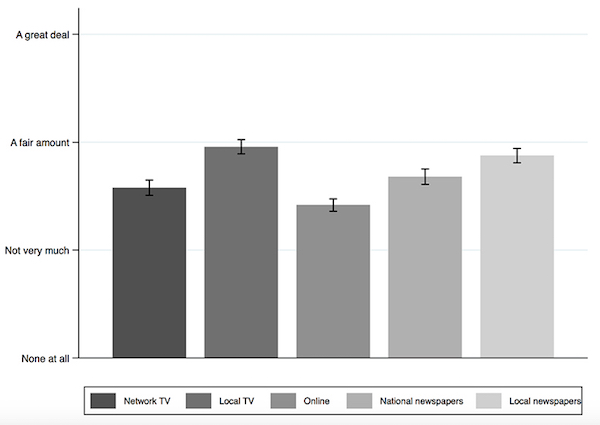 Average media trust by outlet type. |
This sense of trust notedly appears at the local level. The Poynter survey found that more than three-quarters of Americans — 76 percent — now have at least a fair amount of trust in local television news, and 73 percent say they trust local newspaper publishers, compared to 55 percent last year.
The surprise reversal follows a decades-long trend of declining trust in the press and seems to have begun sometime last year, correlating with Donald Trump’s presidency, a man known for his relentless attacks on the media.
Poynter’s 2017 Media Trust Survey last year found that overall trust and confidence in the media surged to its highest levels since 2001, though remained markedly lower among those identifying as Republican, with 44 percent claiming they believe the media fabricates stories about Trump on a regular basis.
This partisan divide remains. While trust and confidence in the press has revealed an upward trend on both political sides, 86 percent of Democrats now say they possess at least a fair amount of trust in the media (a 12-percent uptick from the last Poynter survey and a 53 percent surge since 2016), while Republican trust and confidence stands at only 23 percent (compared to 19 percent in 2017 and 14 percent two years ago.) More than half of Democrats — 55 percent — believe the media “deal fairly with all sides,” but less than 10 percent of Republicans believe that statement.
Reflecting the national trend, Republicans’ trust in the media appears far more pronounced at the local level. Nearly three-quarters of Republicans — 73 percent — said they trust their local TV news station, and 62 percent trust their local newspaper.
The latest Poynter Media Trust Survey was conducted using a representative sample of the U.S. population by market research firm YouGov.

 Trump Media & Technology Group today reported a $58.2M net loss on $4.1M in 2023 revenues, a disclosure that drove its stock price down 22.6 percent to $47.96.
 Barry Pollack, an attorney at Wall Street’s Harris St. Laurent & Wechsler, has registered Julian Assange as a client with the Justice Dept. “out of an abundance of caution.”
 Paramount Global to slash 800 jobs in what chief executive Bob Bakish calls part of an effort to “return the company to earnings growth"... Rolling Stone editor-in-chief Noah Shachtman is exiting at the end of the month due to disagreements with chief executive Gus Wenner over the direction the magazine is taking... The New York Times broke the $1 billion barrier in annual revenue from digital subscriptions in 2023... Press Forward is investing more than $500 million to strengthen local newsrooms.
 The majority of news articles are read within the first three days of publication, according to a recent report.
 The Los Angeles Times gives pink slips to 115 people or 20 percent of its newsroom staff... TIME is also laying off about 30 employees, which is approximately 15 percent of its editorial staff... The Baltimore Banner, which was launched by Stewart Bainum in 2022 after he failed to buy the Baltimore Sun, added 500 subscribers per day in the three days following Sinclair Broadcast Group's deal to purchase the Sun.


 Have a comment? Send it to
No comments have been submitted for this story yet.