
 Andrew Koneschusky |
The retail industry has a lot of work to do to prepare itself for the challenges and risks posed by the introduction of artificial intelligence, according to the AI Risk Index, a new statistical tool developed by Omnicom Public Relations Group’s AI Impact Group.
The AI Impact Group is a new consultancy that brings together specialists from OPRG units CLS Strategies, FleishmanHillard, Maslansky + Partners, Ketchum, Porter Novelli and VOX Global.
Its purpose is to help clients identify the potential threats to their corporate reputations that could result from AI, and to devise strategies for dealing with those threats.
Led by Andrew Koneschusky, partner at CLS Strategies, the AI Impact Group combines research and advanced analytics into proprietary reputation-focused risk assessments.
For their first AI Risk Index, they looked at the retail, manufacturing and transportation sectors to determine how well each was prepared for the impact of AI. Scores on the index range from 0 (no risk preparedness) to 100 (high risk preparedness).
The retail industry was the least prepared of the three sectors, with an overall score of 44.0. The manufacturing sector came in second (49.3 overall score) and transportation, with a 55.3 overall score, did the best.
The study’s authors note, however, that there is a great deal of variation within each sector (scores in the transportation sector, for example, ranged from 37.7 to 68.8), and that even the highest-rated of the companies in the study was not fully prepared for the transformational changes that AI will cause.
They also cite an International Data Corporation study that attests to the rapid growth of AI across all sectors. While worldwide spending on AI in 2017 was estimated at $12 billion, the study predicts that by 2021, that number will hit $57.6 billion.
“Companies that plan for AI and communicate effectively around it will be well positioned to take advantage of the many benefits the technology brings,” said Koneschusky. But he also warns that “there are serious consequences for those who blindly chase the benefits without understanding the risks.”

 Brand has a powerful effect on a company’s valuation, but the level of brand understanding in the investment community leaves a lot to be desired, according to a new study from Brodeur Partners, Interbrand and NewtonX.
 AI may still be viewed with a wary eye by most media pros, but its use is growing, according to a new study from Muck Rack.
 A new study from Walker Sands says that some marketers have been putting the cart before the horse when it comes to the relationship between marketing channels and business outcomes.
 Thought leadership can make made B2B brands more "powerful and attractive to buyers," according to Edelman report.
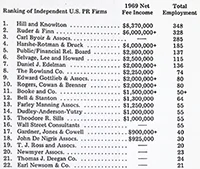 The deadline for O'Dwyer's 2024 rankings of PR firms, a benchmark study of the growth of the industry annually since 1970, is Mon., Mar. 11, 2024.

 Have a comment? Send it to
No comments have been submitted for this story yet.