
 |
The increasing importance of online shopping and expectations about the economy are set to impact the buying decisions women make as the holiday shopping season swings into high gear, according to a new survey from Lippe Taylor and women’s influencer platform SheSpeaks.
Black Friday, which has long been thought of as the season’s biggest shopping day, now takes a backseat to Cyber Monday. While 53 percent of survey respondents said they planned to shop on Black Friday, 62 percent said they planned to do so on Cyber Monday.
That change reflects the power of e-commerce. Only seven percent of respondents said that they planned to do all or almost all of their holiday shopping offline. And while brick-and-mortar shopping has not totally become a thing of the past (only 10 percent said they would do all or almost all of their shopping online), 25 percent of respondents said they would do 75 percent of their shopping online, and 42 percent said they would split their holiday purchases 50-50 between e-retailers and physical stores.
|
|
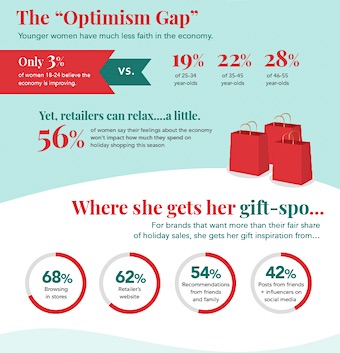
The survey also addressed what it calls an “Optimism Gap” about the economy between women in various age brackets. Just three percent of those in the 18-24 age group said they think the economy is getting better. That number rises to 19 percent for women between 25 and 34, 22 percent for women between 35 and 45, and 28 percent for women between 46 and 55.
Lippe Taylor CEO Maureen Lippe said that gap “is something that brands and retailers should keep in mind when trying to understand the shopping mindset of younger women this holiday season.”
However, while optimism about the economy may be low, many women say that it will not be a deciding factor in their holiday shopping decisions. Overall, 56 percent of respondents said their feelings about the economy, good or bad, won’t impact how much they spend on holiday shopping.
Perhaps another sign of the economic times is the willingness of most of the women surveyed to engage in regifting, with 55 percent saying that they have re-gifted an item for the holidays. The most common items to be passed along were jewelry, candles, lotion and wine accessories.
The SheSpeaks/Lippe Taylor Women’s Buying Behavior Index surveyed over 2,000 women between Oct. 10 and 20.

 Consumers who once demanded convenience now require consistent, multi-channel experiences that cater to them at every point. Brands must have a clear, audience-appropriate, and channel-specific voice across all platforms.
 Employees at U.S. companies are experiencing high levels of burnout, but managers are lagging behind when it comes to their awareness of the problem
 Brand has a powerful effect on a company’s valuation, but the level of brand understanding in the investment community leaves a lot to be desired, according to a new study from Brodeur Partners, Interbrand and NewtonX.
 AI may still be viewed with a wary eye by most media pros, but its use is growing, according to a new study from Muck Rack.
 A new study from Walker Sands says that some marketers have been putting the cart before the horse when it comes to the relationship between marketing channels and business outcomes.


 Have a comment? Send it to
No comments have been submitted for this story yet.