
Consumers are aware of how their purchasing decisions impact the world, and the public’s perception of brands are determined largely by their commitment to social causes they believe in. In fact, according to a new report from Washington, D.C.-based research and consulting firm Clutch, the social stances a company takes now influence buying decisions more than price.
The Clutch survey, which sought to uncover how corporate social responsibility initiatives influence consumers’ buying decisions, discovered that environmentally-friendly business practices now take far more precedence among consumers as an important attribute (71 percent) for companies to have than price (44 percent).
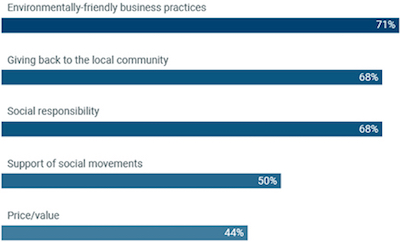 Company attributes people find most important. |
A company’s commitment to social responsibility and giving back to the local community also ranked as more important business attributes than price (both 68 percent).
Altogether, 71 percent of consumers polled said it’s important for businesses to take a stance on social causes.
Three-quarters of respondents (75 percent) said they’re more inclined to begin shopping at a company that supports an issue they personally agree with. By contrast, consumers are also motivated to distance themselves from companies that don’t share their values: more than half (59 percent) said they’re likely to stop purchasing from a company that supports an issue with which they personally disagree.
Not surprisingly, younger consumers are more likely to expect businesses’ values to align with their own. 70 percent of respondents who identified themselves as members of Gen X and 54 percent of those identifying as Millennials said they’re likely to stop shopping at a company that supports an issue with which they disagree, compared to only 37 percent of Baby Boomers who said the same.
Finally, the study confirmed that many consumers remain skeptical of companies’ support of social causes. Nearly a third (29 percent) said they think businesses simply engage in CSR to earn money, though nearly the same number (28 percent) said they think businesses genuinely care about the issues they claim to support.
Clutch’s "2019 PR and Corporate Social Responsibility Survey" polled more than 400 U.S. adults who reported making a purchase within the last five months. The survey was conducted in 2018’s fourth quarter by brand intelligence research company Survata.

 Consumers continue to place a premium on corporate responsibility, but they increasingly want to see that responsibility directed toward issues that affect the bottom line, according to a new study from Mission North
 Not all pressing issues require corporate voice! Brand stewards must must ask why and when their brands should engage, or if they need to engage on a particular issue at all.
 Dollar General investors voted in support of a shareholder resolution at its May 31 annual meeting for an independent third party audit of “worker safety and well-being.”
 Nonprofits and philanthropists have a unique opportunity to take ownership of conversations surrounding pressing social issues.


 Have a comment? Send it to
No comments have been submitted for this story yet.