
 |
While CEOs may be under increasing pressure to speak out on social issues, that doesn’t necessarily mean they are making it a priority, according to a new study from the USC Annenberg Center for Public Relations and Chief Executive magazine.
About 60 percent of the 210 CEOs surveyed for the study said they were unlikely to communicate about any social issue in 2019.
The main communications goal for most of the CEOs surveyed remains the bottom line, with 44 percent saying that selling their products and services is the top message they are concerned with delivering. Differentiating a company’s brand from its competition was cited by 39 percent as the primary goal of their corporate communications.
“At a time when high-profile corporations like Nike and Levi Strauss are speaking out about societal issues, it’s fascinating to see that the majority of CEOs have little interest in being part of that conversation,” said Fred Cook, director of the Annenberg Center.
However, for those CEOs who were planning to speak out, the most pressing topics were considered to be data privacy (18 percent), healthcare (17 percent) and diversity and inclusion (11 percent). “Fake news” was listed as a priority by only five percent of respondents.
The survey also asked CEOs to name the communications channels that they thought would be most valuable to their companies in the future. Social media and influencers topped that list, with 30 percent choosing them. Close behind was owned media, which was selected by 29 percent. Traditional media (11 percent) and advertising (nine percent) both trailed considerably.
CEOs also felt rather confident about the ability of their companies to deal with the growing role of technology in corporate communications. More than half said their company’s use of new technologies to enhance their communications programs was either good or excellent.
The survey is part of USC Annenberg’s annual report on the PR industry. An online survey directed toward communications professionals is being conducted through Feb. 8. To take the survey, click here.

 Brand has a powerful effect on a company’s valuation, but the level of brand understanding in the investment community leaves a lot to be desired, according to a new study from Brodeur Partners, Interbrand and NewtonX.
 AI may still be viewed with a wary eye by most media pros, but its use is growing, according to a new study from Muck Rack.
 A new study from Walker Sands says that some marketers have been putting the cart before the horse when it comes to the relationship between marketing channels and business outcomes.
 Thought leadership can make made B2B brands more "powerful and attractive to buyers," according to Edelman report.
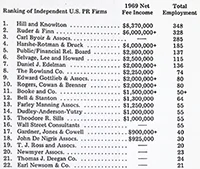 The deadline for O'Dwyer's 2024 rankings of PR firms, a benchmark study of the growth of the industry annually since 1970, is Mon., Mar. 11, 2024.


 Have a comment? Send it to
No comments have been submitted for this story yet.