
 |
Firms in the fintech sector outpace those in other areas of finance when it comes to content marketing.
That’s the verdict of “First the Content, Then Domination,” a new study from BackBay Communications. According to the study, an overwhelming 96 percent of the top 100 fintech companies produce thought leadership regularly.
Not only are most fintech firms producing content, they are also churning it out at a steady clip. About two-thirds of those who produce content (66 percent) do so on at least a monthly basis, and 42 percent say that they publish new content weekly.
 |
“It could be argued that content is so ubiquitous in the sector, it now seems glaring when companies aren’t producing and publishing thought leadership regularly,” the study’s authors say.
They are also putting out their content on multiple platforms. Nearly half (47 percent) say they use at least three mediums for the content they generate. Insights or blogs were the most popular medium used (88 percent), with videos (86 percent) close behind. Podcasts are used by 45 percent.
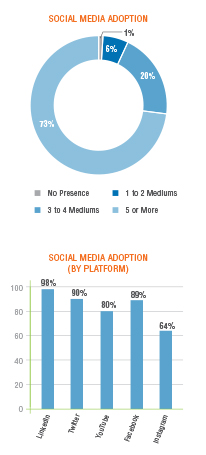
Maintaining a social media profile has also become standard practice for fintech companies. Just about all of them (99 percent) are on at least one platform, and 73 percent have a presence on five or more social platforms.
LinkedIn was the most popular platform, with 98 percent of social media adopters using it. Twitter came in at second with 90 percent, followed by Facebook (89 percent), YouTube (80 percent) and Instagram (64 percent).
The study looked at the 50 largest and the 50 most promising fintech companies, according to KPMG’s dual rankings, and analyzed what is publicly available on the companies’ website and through social media.

 Employees at U.S. companies are experiencing high levels of burnout, but managers are lagging behind when it comes to their awareness of the problem
 Brand has a powerful effect on a company’s valuation, but the level of brand understanding in the investment community leaves a lot to be desired, according to a new study from Brodeur Partners, Interbrand and NewtonX.
 AI may still be viewed with a wary eye by most media pros, but its use is growing, according to a new study from Muck Rack.
 A new study from Walker Sands says that some marketers have been putting the cart before the horse when it comes to the relationship between marketing channels and business outcomes.
 Thought leadership can make made B2B brands more "powerful and attractive to buyers," according to Edelman report.


 Have a comment? Send it to
No comments have been submitted for this story yet.