
 |
| John Saunders |
Despite the reputational hits that the tech sector has been taking recently, a new study from FleishmanHillard finds that in the US and UK, trust in tech remains surprisingly high.
“From Darlings to Damaged? Managing the Technology Sector’s Reputation in an Age of Heightened Security” asked consumers in both countries about their attitudes and perceptions regarding the tech industry’s reputation.
The main takeaway: While most consumers trust the tech industry, a sizeable group is skeptical.
More than eight out of 10 (82 percent) of American respondents said they generally trust tech companies, and almost as many in the UK (79 percent) said the same.
When it comes to those who don’t trust tech, there is a generation gap in both countries, but it manifests itself in very different ways. In the US, younger consumers are more likely to be dubious about tech companies than their elders, with 22 percent of Millennials and 26 percent of Gen Z respondents voicing skepticism.
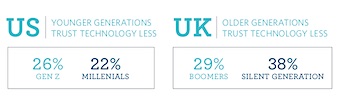 |
However, in the UK, older consumers are more prone to show their distrust, with 38 percent of Silent Generation respondents (those born before 1945) and 29 percent of Boomers saying they did not trust tech companies.
Even though trust levels across the board are positive, a majority of respondents from both countries (70 percent) said that tech companies should increase their efforts to address such issues as the accessibility of user information, data breaches and general security.
That sentiment does not completely hold when it comes to regulation. Only 31 percent of respondents said that they thought tech companies are regulated too little.
Interestingly, while 60 percent of British respondents felt that UK tech companies were regulated about the right amount, only 54 percent felt the same with regard to US companies. The study’s authors say those numbers indicate that UK consumers think there is a more relaxed attitude toward tech sector regulation in the US.
“As companies navigate the increasingly complex environment, the best approach is to commit to being transparent, and to work collaboratively with government, regulators and academia,” said FleishmanHillard president and CEO John Saunders.

 Consumers who once demanded convenience now require consistent, multi-channel experiences that cater to them at every point. Brands must have a clear, audience-appropriate, and channel-specific voice across all platforms.
 Employees at U.S. companies are experiencing high levels of burnout, but managers are lagging behind when it comes to their awareness of the problem
 Brand has a powerful effect on a company’s valuation, but the level of brand understanding in the investment community leaves a lot to be desired, according to a new study from Brodeur Partners, Interbrand and NewtonX.
 AI may still be viewed with a wary eye by most media pros, but its use is growing, according to a new study from Muck Rack.
 A new study from Walker Sands says that some marketers have been putting the cart before the horse when it comes to the relationship between marketing channels and business outcomes.


 Have a comment? Send it to
No comments have been submitted for this story yet.