
The total daily time Americans spent on social media networks took a dip last year, the result of Facebook users now spending less time on that platform, according to recent analysis by digital market research company eMarketer.
Average daily time spent on Facebook by U.S. adults fell by about three minutes last year, according to eMarketer, from 41 minutes per day in 2017 to 38 minutes in 2018.
Because the platform accounts for the lion’s share of overall social media activity in the U.S., the average daily time Americans spent with social media in 2018 declined by about a minute—or 1.9 percent—to an hour and 14 minutes.
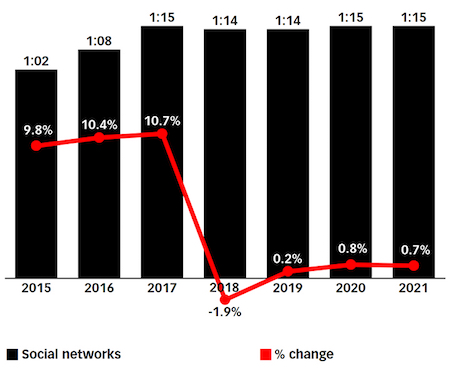 Average daily time spent on social media platforms by U.S. adults, 2015-2021 (hrs: mins per day). Average daily time spent on social media platforms by U.S. adults, 2015-2021 (hrs: mins per day). |
By contrast, overall social media use time saw cumulative gains of about seven minutes between 2016 and 2017 alone or 10.7 percent, and a similar six-minute gain between 2015 and 2016, or 10.4 percent. eMarketer predicts the average time Americans spend on social media networks will now remain essentially flat through 2021.
eMarketer also estimates that the average daily time Americans spend on Facebook will continue to decline modestly over the next few years, remaining at 38 minutes per day in 2019 before sliding by about a minute to 37 minutes per day in 2020.
On the other hand, eMarketer posited that the rising popularity of photo-sharing site Instagram paints a different picture, and is a primary reason why the total daily time Americans spend on social media didn’t plummet more last year. eMarketer predicts that U.S. adult Instagram users will spend an average of 27 minutes per day on the site this year, up from 26 minutes per day in 2017-2018 and 24 minutes per day in 2016
eMarketer also predicts that American adults’ use of messaging app Snapchat will remain essentially flat, with future average daily time forecasts remaining unchanged through 2021.

 What if companies could harness the fury of online outrage into a force for good? This is precisely where companies can start turning the trolls into brand champions.
 Audiences interacted with brand content far more often on Facebook and Instagram in 2023 than they did via X (formerly Twitter), according to a report that tracked engagement trends across different social networks.
 Can public relations help counteract the dissension fostered by the power of digital platforms to spread hate, fear and confusion?
 The number of Americans who get their news from TikTok has quadrupled in the last three years, according to a recent Pew Research Center report.


 Have a comment? Send it to
No comments have been submitted for this story yet.