
Local news coverage plays a vital role for increasingly smaller groups of Americans today, according to a new report released by the Pew Research Center.
Pew’s analysis, which illustrated the differences in Americans’ local news preferences across various demographic differences—age, race/ethnicity and education level—found that, altogether, only about a third of U.S. adults (31 percent) currently follow the local news “very closely.”
Among those who still maintain an interest in the local news, Pew’s analysis additionally found these Americans are also considerably more likely to fall within three key demographic groups than their counterparts. Statistically, they’re more likely to be older, they’re more likely to have only a high school education or less, and they’re more likely to be African American.
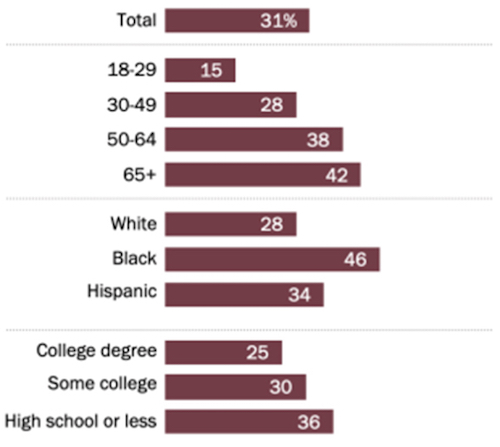 Percentage of American adults who follow the news “very closely.” Percentage of American adults who follow the news “very closely.” |
According to the report, only 15 percent of Americans ages 18 to 29 said they follow the local news very closely, compared to nearly a third (28 percent) of those ages 30 to 49 and about four-in-ten (38 percent) of those 50 and older. The largest audience of local news devotees consisted of those ages 65 and up (42 percent).
Moreover, only about a quarter of Americans with a college degree (25 percent) said they’re very interested in local news, compared to less than a third of those who’ve attended some college (30 percent). A majority of Americans who expressed a strong interest in local news (36 percent) reported having a high school education or less.
Finally, only a little more than a quarter (28 percent) of white Americans said they follow the local news very closely, compared to about a third (34 percent) of Hispanics. On the other hand, nearly half of black Americans (46 percent) expressed a strong connection to the local news.
The report also discovered that more than half of Americans ages 50 and older (51 percent) prefer television above all other mediums for getting their local news, while 60 percent of adults ages 18 to 29 find local news via the Internet. Americans with a high school degree or less were also more likely to prefer TV (52 percent), compared with 29 percent of those with a college degree and 39 percent of those with some college education. And black Americans were far more likely (59 percent) than Hispanic or white Americans to follow local news via TV (44 percent and 38 percent, respectively).
Pew’s analysis also found that few U.S. adults—only 14 percent—said they pay for local news service anymore, be it through subscriptions, paid membership or donations. Americans 65 and older are the most likely to pay for local news (29 percent), followed by those between the ages of 50 and 64 (15 percent). Of the younger generations, only nine percent of those ages 30 to 49 said they pay for local news, followed by seven percent of those ages 18 to 29.
Of those surveyed who don’t pay for local news, a majority said the reason they don’t pay for it is due to the fact that plenty of local news is available for free. This was followed by a consensus that they don’t find local news interesting enough to pay for. Only about 12 percent of Americans polled cited cost as a reason for not paying for a local news service.
There’s one local news topic, however, most Americans still appear to value equally: the weather. According to the report, about 70 percent of white, black and Hispanic Americans all consider the weather important to their daily lives.
The Pew Research Center report surveyed almost 35,000 U.S. adults online between October and November 2018.

 Trump Media & Technology Group today reported a $58.2M net loss on $4.1M in 2023 revenues, a disclosure that drove its stock price down 22.6 percent to $47.96.
 Barry Pollack, an attorney at Wall Street’s Harris St. Laurent & Wechsler, has registered Julian Assange as a client with the Justice Dept. “out of an abundance of caution.”
 Paramount Global to slash 800 jobs in what chief executive Bob Bakish calls part of an effort to “return the company to earnings growth"... Rolling Stone editor-in-chief Noah Shachtman is exiting at the end of the month due to disagreements with chief executive Gus Wenner over the direction the magazine is taking... The New York Times broke the $1 billion barrier in annual revenue from digital subscriptions in 2023... Press Forward is investing more than $500 million to strengthen local newsrooms.
 The majority of news articles are read within the first three days of publication, according to a recent report.
 The Los Angeles Times gives pink slips to 115 people or 20 percent of its newsroom staff... TIME is also laying off about 30 employees, which is approximately 15 percent of its editorial staff... The Baltimore Banner, which was launched by Stewart Bainum in 2022 after he failed to buy the Baltimore Sun, added 500 subscribers per day in the three days following Sinclair Broadcast Group's deal to purchase the Sun.


 Have a comment? Send it to
No comments have been submitted for this story yet.