
 |
| Imran Khan |
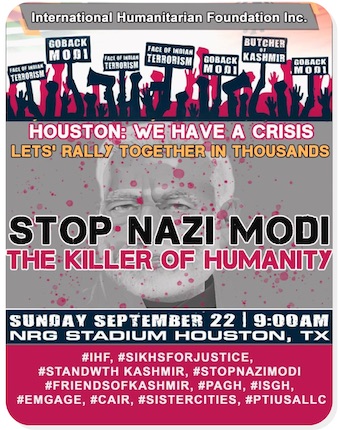
The International Humanitarian Foundation, which advocates for Pakistan, hired Fenton Communications to educate the US media and public about the human rights crisis in Kashmir, the disputed region controlled by India and Pakistan.
In August, India stripped its portion of Kashmir of its autonomy, moved in thousands of troops, made mass arrests, issued a curfew and cut communications links to the outside world to put down an uprising against Indian rule, according to Reuters.
Pakistan prime minister Imran Khan warned the United Nations Sept. 25 that the crackdown of the Muslim-majority region by India prime minister Narendra Modi, who represents the Hindu nationalist Bharatiya Janata party, could trigger a nuclear war.
 |
Since independence in 1947, India and Pakistan have fought two wars over Kashmir.
Houston-based IHF is headed by Sajjad Burki, US representative of Pakistan’s Tehreek-e-Insaf centrist political party.
It helped organize a rally in Houston on Sept. 22 to protest the “Howdy Modi!” event at NRG Stadium that attracted 50K Indian Americans and Donald Trump, who called Modi “the father of India.”
Fenton signed a $50K contract with the IHF on Sept. 19 to cover work through Sept 30.
The job is to highlight the “gross human rights violations taking place in Kashmir and attempts by various parties to open dialogue to resolve the situation peacefully.”
David Fenton and Ira Arlook, chief of advocacy, handle the work.

 There’s a fine line between newsjacking and taking advantage, aka ambulance chasing. Our job as PR professionals is to tread it carefully.
 PR firms need to be mindful of ways their work product may be protected by the attorney-client privilege whenever working with a client’s internal legal team or its external legal counsel.
 Manuel Rocha, former US ambassador and intenational business advisor to LLYC, plans to plead guilty to charges that he was a secret agent for Cuba.
 CEO mentoring is an often-overlooked aspect of why CEOs are able to make good decisions, and sometimes make bad ones—all of which intersects with the role and duties of a board.
  How organizations can anticipate, prepare and respond to crises in an increasingly complex world where a convergent landscape of global challenges, threats and risks seem to arrive at an unrelenting pace.


 Have a comment? Send it to
No comments have been submitted for this story yet.