
Trade groups representing the U.S. technology sector were ranked as the most effective- performing lobbying sector for achieving results on Capitol Hill, according to a research study of Washington policy leaders released by APCO Worldwide.
The study surveyed U.S. executive branch officials, congressional staff and private sector executives and asked them to identify what associations they believe are the most effective in delivering policy results for their members, measuring perceived performance and effectiveness across 15 separate effective public policy characteristics.
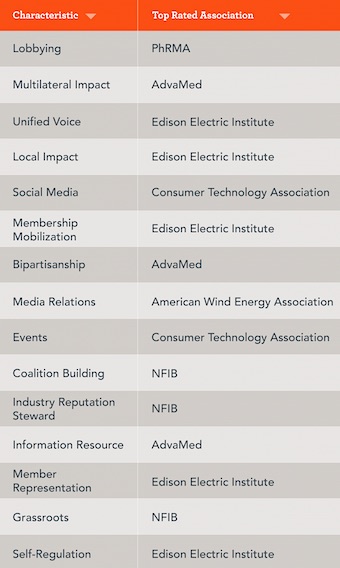 |
| The table displayed shows which association has the highest performance rating on each of the 15 characteristics that comprise the TradeMarks Model. |
A half-dozen specific associations were identified as top performers in this year’s study. Half of those were groups representing the tech industry. The top-rated group for the most categories was electric company association the Edison Electric Institute, which won for local impact, member representation, membership mobilization, self-regulation and for providing a unified voice. Consumer technology group the Consumer Technology Association won for events and social media. The American Wind Energy Association won for media relations.
Healthcare groups rounded out the rest of the wins. Medical device trade association AdvaMed won in three categories: for multilateral impact, bipartisanship and for serving a top information resource. PhRMA won for lobbying.
The only non-tech or healthcare group to appear on the list was the National Federation of Independent Business, which won for grassroots work, coalition building and for being an industry reputation steward.
It’s the second year in a row that the APCO TradeMarks study gave trade associations representing the tech sector the most wins for effectively-viewed specific advocacy area characteristics. Previous versions of the study found that healthcare groups were most often considered the top-performing lobbying sector in the most areas.
Overall, however, healthcare groups remain perceived as the top sector-specific advocacy area on Capitol Hill. Technology comes in sixth overall, above lobbying associations representing food/beverage and retail and immediately below financial services, manufacturing, and energy/extraction groups.
The study also found that, collectively, trade associations remain highly-regarded among Beltway insiders for their ability to successfully advocate public policy in Washington. The 50 trade groups assessed by policy leaders recorded the highest aggregate score since APCO’s survey began in 2013, an especially impressive feat considering today’s uncertain policy landscape.
When it comes to the specific characteristics policy leaders believe today’s trade groups excel at getting results, lobbying, multilateral impact, unified voice and local impact were the top-performing characteristics. Social media, bipartisanship and media relations followed, while grassroots efforts, member representation and self-regulation bottomed out the list.
APCO’s sixth annual TradeMarks study surveyed 321 Washington policy leaders, which included congressional staff, executive branch officials and private sector executives. Research was conducted by the agency’s in-house research team, APCO Insight.

 Carlsbad, a north San Diego County city of 115K people, is looking for a firm to provide government relations and Sacramento lobbying services.
 Gordon Sondland, who was US ambassador to the European Union under Donald Trump, has registered as a representative of Ukraine’s cabinet and ministers.
 The Daschle Group is representing Santa Monica-based Stand with Hong Kong Action, an advocacy group that fights to end Chinese repression in Hong Kong.
 McKinsey & Co. has reached out to Republican shop Harbinger Strategies to educate policymakers about the activities of the embattled management consultancy.
 Scotland’s SaxaVord Spaceport, which is the UK’s only facility for vertical rocket launches, has hired Alexandria’s Brian Glackin & Assocs. for Washington representation on aerospace and defense matters.

 Have a comment? Send it to
No comments have been submitted for this story yet.