
 |
Being perceived as innovative gives brands a boost in today’s marketplace—and tech plays a big role in creating that perception, according to a new report from Diffusion.
About one of five consumers surveyed for Diffusion’s Everything Is Tech 2019 report (19 percent) said that they would be more likely to give their business to a brand that they thought of as innovative, rather than to a competing brand.
A significant number of people were also interested in learning more about innovative brands, with 21 percent saying there was a greater chance that they would open an email from an innovative brand, and 29 percent saying they were more likely to seek out and read news articles about an innovative brand.
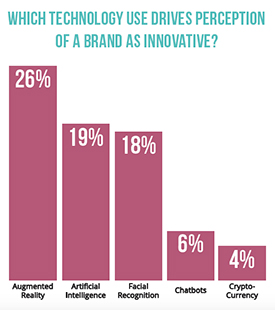 |
Some emerging technologies had a larger effect than others on making a brand appear innovative, the survey respondents said. More than a quarter of them (26 percent) thought that using augmented reality makes a company look more innovative, while artificial intelligence came in second (19 percent) and facial recognition technology (18 percent) was close behind. Chatbots (6 percent) and cryptocurrency (4 percent) lagged behind.
As regards what consumers expect advanced technologies to do for them, 44 percent said they want the technologies to facilitate shopping experiences, while 33 percent want to them implement to improve customer service and 30 percent wanted such technologies as drones and warehouse organization to be employed in an effort to make deliveries more convenient.
The online study of 1,236 adults conducted on April 18 and 19.

 Consumers who once demanded convenience now require consistent, multi-channel experiences that cater to them at every point. Brands must have a clear, audience-appropriate, and channel-specific voice across all platforms.
 Employees at U.S. companies are experiencing high levels of burnout, but managers are lagging behind when it comes to their awareness of the problem
 Brand has a powerful effect on a company’s valuation, but the level of brand understanding in the investment community leaves a lot to be desired, according to a new study from Brodeur Partners, Interbrand and NewtonX.
 AI may still be viewed with a wary eye by most media pros, but its use is growing, according to a new study from Muck Rack.
 A new study from Walker Sands says that some marketers have been putting the cart before the horse when it comes to the relationship between marketing channels and business outcomes.


 Have a comment? Send it to
No comments have been submitted for this story yet.