
Partisanship influences how Americans perceive the news media more than any other factor, according to a new study released by the Pew Research Center.
The study, which sought to understand what factors influence public trust in the news media today, suggests that in the Trump Era, a direct relationship exists between Americans’ political party identification and whether they hold a favorable view of journalists and the news media.
Overall, the study discovered that Republicans are consistently more likely to express skepticism of the news media and their motives than Democrats: about a third of Republicans (30 percent) as well as Republican-leaning independents (31 percent) said they believe journalists have “very low” ethical standards, about six times the percentage of Democrats (five percent) and Democratic-leaning independents who believe this.
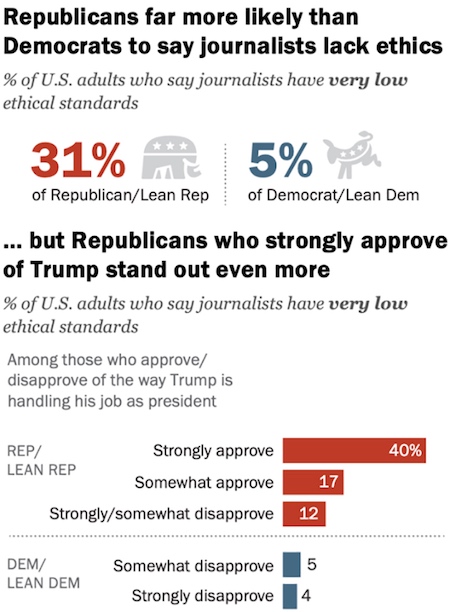 |
In fact, the study found that the more a respondent approves of President Trump’s performance, the more likely he/she is to exhibit a distrust toward the media.
For example, among the most fervent Trump supporters polled—those who said they “strongly approve” of Trump’s job performance—40 percent characterized journalists’ ethical standards as “very low.” By contrast, only 17 percent of Republicans who said they only somewhat approve of Trump exhibited such suspicion toward the media, and only 12 percent of Republicans who disapprove of Trump do so.
The study also found that other factors are also likely to influence Americans’ trust in the news, including the extent to which that person is engaged with national politics, as well as race (black Americans often exhibit greater support of news organizations and journalists than Hispanic or white Americans), age (older Americans are typically more loyal to their preferred news sources than younger adults) and whether that person expresses greater general trust in others.
None of these variables, however, were such reliable indicators of respondents’ perceived trust toward journalists and the news media as political affiliation.
“No other factors in this study come close to these partisan dynamics in their relationship to Americans’ views,” the study’s authors wrote.
Pew’s report, “Trusting the News Media in the Trump Era” relied on data drawn from more than 50 different surveys conducted by the Center’s American Trends Panel between 2014 and 2019.

 Trump Media & Technology Group today reported a $58.2M net loss on $4.1M in 2023 revenues, a disclosure that drove its stock price down 22.6 percent to $47.96.
 Barry Pollack, an attorney at Wall Street’s Harris St. Laurent & Wechsler, has registered Julian Assange as a client with the Justice Dept. “out of an abundance of caution.”
 Paramount Global to slash 800 jobs in what chief executive Bob Bakish calls part of an effort to “return the company to earnings growth"... Rolling Stone editor-in-chief Noah Shachtman is exiting at the end of the month due to disagreements with chief executive Gus Wenner over the direction the magazine is taking... The New York Times broke the $1 billion barrier in annual revenue from digital subscriptions in 2023... Press Forward is investing more than $500 million to strengthen local newsrooms.
 The majority of news articles are read within the first three days of publication, according to a recent report.
 The Los Angeles Times gives pink slips to 115 people or 20 percent of its newsroom staff... TIME is also laying off about 30 employees, which is approximately 15 percent of its editorial staff... The Baltimore Banner, which was launched by Stewart Bainum in 2022 after he failed to buy the Baltimore Sun, added 500 subscribers per day in the three days following Sinclair Broadcast Group's deal to purchase the Sun.


 Have a comment? Send it to
No comments have been submitted for this story yet.