
 |
While business leaders across the board are becoming increasingly aware of the strong ties between corporate reputation and the bottom line, a group of execs who say reputation is a particularly important factor in a company’s market value are pointing the way to how those reputations can be built and maintained.
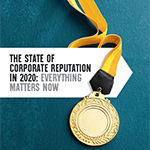
“The State of Corporate Reputation in 2020: Everything Matters Now,” a survey conducted by Weber Shandwick in partnership with KRC Research, terms that group the “76 Percenters,” those execs who think that more than three-quarters of their company’s market value can be directly linked to its reputation. For the study as a whole, respondents said that 63 percent of their company’s market value was driven by reputation.
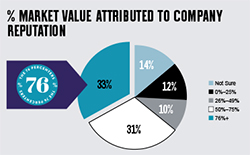 |
The differences between the 76 Percenters and the overall sample starts at the top. Four out of five 76 percenters say the reputation of their CEO is directly tied to the reputation of the company. Only 58 percent of the total sample makes that claim.
Out of the 23 “reputation drivers” presented to survey respondents, the 76 Percenters assigned every one more importance than did the group as a whole. Some of the biggest gaps were in community relations (11 percentage points—65 percent vs. 54 percent), industry leadership, corporate culture and environmental responsibility (a 10 percentage-point gap for all three).
The role of marketing and communication also ranks higher for the 76 Percenters, with 63 percent calling it an important driver of their reputations. For all respondents, the number was 55 percent.
The 76 Percenters are more likely to monitor their company’s reputation, with 83 percent saying they do so, as opposed to 71 percent for the overall survey.
In the overall survey, most respondents gave the reputation of both their company (87 percent) and their CEO (82 percent) high marks. That positive attitude toward company reputation seems to be a worldwide phenomenon, ranging from 98 percent in India and China to 75 percent in South Korea.
The general study also found that reputation depends on an ever-widening array of factors—from quality of products and services to corporate culture and purpose—resulting in what the study author’s call an “omnidriven” reputation landscape.
“Companies can no longer solely focus on and prioritize just a few key drivers of reputation,” the study notes. “Everything matters to reputation today. Reputation’s day of judgment has certainly arrived in full force.”
“The State of Corporate Reputation in 2020” surveyed 2,227 executives worldwide. Respondents were in mid- to high-level positions at companies with at $500 million in revenue in developed markets and $250 million in less developed markets.

 Consumers who once demanded convenience now require consistent, multi-channel experiences that cater to them at every point. Brands must have a clear, audience-appropriate, and channel-specific voice across all platforms.
 Employees at U.S. companies are experiencing high levels of burnout, but managers are lagging behind when it comes to their awareness of the problem
 Brand has a powerful effect on a company’s valuation, but the level of brand understanding in the investment community leaves a lot to be desired, according to a new study from Brodeur Partners, Interbrand and NewtonX.
 AI may still be viewed with a wary eye by most media pros, but its use is growing, according to a new study from Muck Rack.
 A new study from Walker Sands says that some marketers have been putting the cart before the horse when it comes to the relationship between marketing channels and business outcomes.


 Have a comment? Send it to
No comments have been submitted for this story yet.