
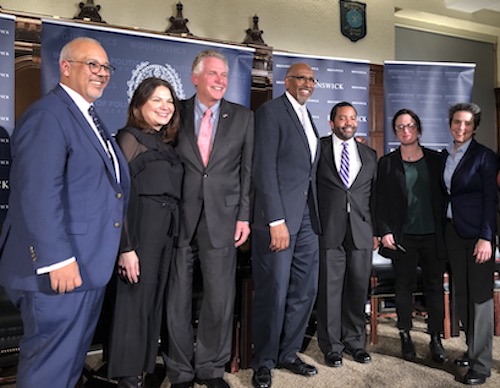
Approximately 250, mostly students, listened as panelists Maggie Haberman of the New York Times, former RNC chairman Michael Steele, former DNC chairman and Virginia governor Terry McAuliffe, Cook Political Report’s Amy Walter, and Brunswick Group partners Patti Solis Doyle and Jonathan Burks dished on the Democratic primaries and the possibility of unseating Donald Trump.
“The press is no longer the gatekeeper,” said Haberman. “We are just covering what’s in front of us and the voters are going to do what they’re going to do with it.”
The panel agreed that the power of national parties and the media are being challenged by new technologies that allow politicians to take their case directly to the people.
 |
|
(L to R) Mo Elleithee, GU Politics Executive Director - Moderator; Jonathan Burks, Brunswick Group Partner, former GU Politics Fellow; Patti Solis Doyle, Brunswick Group Partner; Terry McAuliffe (D-Va.), former Governor of Virginia; Michael Steele, former Republican National Committee Chairman; Maggie Haberman, New York Times White House Correspondent; Amy Walter, Cook Political Report National Editor |
“Politics has changed,” said Solis Doyle. “The way we measure politics, the metrics by which we measure, that’s different. We can’t measure accurately anymore. The way we receive information has changed; the way we disseminate information has changed.”
Solis Doyle, a veteran presidential campaign strategist, and Burks, former chief of staff to Speaker Paul Ryan, are recent additions to Brunswick’s D.C. office.
“The Road to 2020” discussion was held Feb. 26 at Georgetown University's Copley Formal Lounge. Brunswick partnered on the event with the school's Institute of Politics and Public Service.
A recording is available here.

 Husch Blackwell Strategies has added FleishmanHillard alum Michael Slatin as a principal in its public affairs group.
 Rory Cooper, a veteran Republican operative and policy specialist, has joined Teneo’s Washington office as senior managing director in its strategy & communications practice.
 Brian Fallon, who served as national press secretary for Hillary Clinton’s 2016 presidential run, is signing on next month as Vice President’s Kamala Harris’ campaign communications director.
 TikTok is nothing more than a Chinese propaganda tool that poses “a grave threat to America’s national security and, in particular, impressionable children and young adults,” say two Congressmen who want the platform registered as a foreign agent.
 Public Strategies Washington has added Abbie Sorrendino, a former aide to now Senate Majority Leader Chuck Schumer.


 Have a comment? Send it to
No comments have been submitted for this story yet.