
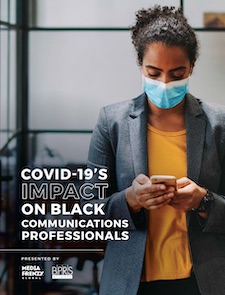
COVID-19 is uniquely impacting Blacks in communications, according to a new survey from Media Frenzy Global and the National Black Public Relations Society.
“COVID-19's Impact on Black Communications Professionals” examines the challenges that those professionals have faced during the COVID-19 pandemic, and finds that the playing field has been far from equal.
 |
More than half of the survey respondents (52 percent) said that they felt more pressure to perform at a higher level than their white counterparts during the pandemic.
That pressure is just one part of the heightened levels of stress that Black communications pros are experiencing. More than three-quarters of respondents (76 percent) said that their on-the-job stress has risen, resulting in a drop in productivity.
Stress is not just coming from the workplace, however, with 72 percent of those surveyed saying that stressors from the “outside community” were also having an effect on their job performance.
Many employers are not doing their part to lessen the effects of that stress, according to the survey. Fifty-four percent of respondents said that their organizations were either not offering more support in the wake of COVID-19—or were actually decreasing it.
A sizeable majority of those surveyed (77 percent) were women—many of whom cited the difficulties of balancing work in the “new normal” with such family responsibilities as homeschooling or childcare.
All of this comes on top of the CDC report that Blacks are five times more likely to be hospitalized by the virus than whites, and the continuing threat of job loss and insecurity.
"COVID-19 has a grave impact on the Black community, especially in the professional realm,” said Media Frenzy Global partner Katie Kern. "There is a clear need for data to be compartmentalized and addressed so that we can take the necessary steps to find and create resources to assist our most vulnerable communities."
The survey was conducted online from June 9 to July 6, with input solicited from communications professionals with connections to seven regional affiliate NBPRS chapters encompassing agency, corporate and independent practitioners in Atlanta, Chicago, Detroit, Los Angeles, New York City, Philadelphia and Washington, DC.

 Brand has a powerful effect on a company’s valuation, but the level of brand understanding in the investment community leaves a lot to be desired, according to a new study from Brodeur Partners, Interbrand and NewtonX.
 AI may still be viewed with a wary eye by most media pros, but its use is growing, according to a new study from Muck Rack.
 A new study from Walker Sands says that some marketers have been putting the cart before the horse when it comes to the relationship between marketing channels and business outcomes.
 Thought leadership can make made B2B brands more "powerful and attractive to buyers," according to Edelman report.
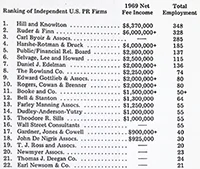 The deadline for O'Dwyer's 2024 rankings of PR firms, a benchmark study of the growth of the industry annually since 1970, is Mon., Mar. 11, 2024.


 Have a comment? Send it to
No comments have been submitted for this story yet.