
 |
| Maria Cantwell |
Local newspapers will all but vanish within five years, largely due to the unfair and abusive practices of tech platforms, according to a study from Democrats on the Senate Commerce Committee that calls for new Federal Trade Commission authority to protect endangered newspapers.
By the end of the five years, newspapers will have lost 70 percent of the revenue that they had in 2000. More than 40,000 newsroom jobs have been cut since 2005 and another 7,000 will be lost this year, leaving a workforce of about 30,000.
“Local news across America creates competition and trusted information,” said Maria Cantwell, ranking Democrat on the Commerce Committee. “We shouldn’t let regional and community news die as local newspapers and broadcasters adjust to digital delivery because online giants are unfairly leveraging the advertising market against them.”
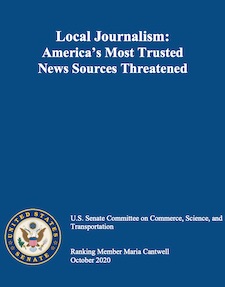 |
Called "Local Journalism: America's Most Trusted News Sources Threatened," the Report notes that the mass transfer of content and advertising online, combined with the proliferation of news sites, has dramatically lowered ad value and siphoned dollars from local newspapers that produce the content supporting those ads.
Meanwhile, “local news has been hijacked by a few large news aggregation platforms, notably Google and Facebook, which have become the dominant players in online advertisers. These trillion-dollar companies scrape local news content and data for their own sites and leverage the market dominance to force local news to accept little to no compensation for their intellectual property.”
The Report says Congress and the FTC should work to ensure fair return for local news content.
They should require news aggregation platforms to enter into good faith negotiations with local news organizations and pay them fair market value for their content.
Local news organizations should also be able to collectively bargain for reuse of their content, provided there are strong controls in place to ensure that smaller publishers are not left behind.
The Report calls for rules to prevent unfair, deceptive and abusive practices to stop platforms from taking local news content without financial payment and retaliating against local news by hiding or removing their content from search engines or social media feeds.
Each of these changes should be crafted in a way to promote competition and consumer welfare and spur growth and innovation in the digital economy.

 Trump Media & Technology Group today reported a $58.2M net loss on $4.1M in 2023 revenues, a disclosure that drove its stock price down 22.6 percent to $47.96.
 Barry Pollack, an attorney at Wall Street’s Harris St. Laurent & Wechsler, has registered Julian Assange as a client with the Justice Dept. “out of an abundance of caution.”
 Paramount Global to slash 800 jobs in what chief executive Bob Bakish calls part of an effort to “return the company to earnings growth"... Rolling Stone editor-in-chief Noah Shachtman is exiting at the end of the month due to disagreements with chief executive Gus Wenner over the direction the magazine is taking... The New York Times broke the $1 billion barrier in annual revenue from digital subscriptions in 2023... Press Forward is investing more than $500 million to strengthen local newsrooms.
 The majority of news articles are read within the first three days of publication, according to a recent report.
 The Los Angeles Times gives pink slips to 115 people or 20 percent of its newsroom staff... TIME is also laying off about 30 employees, which is approximately 15 percent of its editorial staff... The Baltimore Banner, which was launched by Stewart Bainum in 2022 after he failed to buy the Baltimore Sun, added 500 subscribers per day in the three days following Sinclair Broadcast Group's deal to purchase the Sun.


 Have a comment? Send it to
No comments have been submitted for this story yet.