
 |
More than 80 percent of the journalists surveyed in a new study say that they still depend on PR professionals for news. However, more than half (53 percent) say that the information they receive is often inaccurate.
The 2021 PR Media Report, conducted by Global Results Communications, polled 1,026 journalists between March and May of this year, asking them how they view PR practitioners.
A large majority of respondents value the relationship between journalists and PR pros. Only 10 percent said that their relationships with PR professionals were “not important.” Close to two-thirds (62 percent) said the relationship was an important one, and over a quarter (28 percent) called PR people “a core resource.”
When it comes to what kind of content journalists are most likely to use, the media release is number-one by a long shot, with 60 percent of respondents citing it as the top source. Such content as pitches/article abstracts (15 percent), press kits (8 percent) and contributed articles (6 percent) lagged considerably behind.
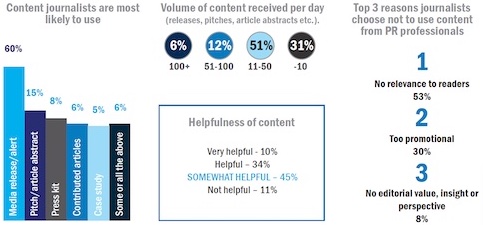 |
Opinions about the helpfulness of content received from PR pros vary considerably. While only 11 percent label such content as “not helpful,” an even smaller number (10 percent) rank it as “very helpful.” Most respondents landed somewhere in the middle, with 34 percent ranking the content they receive as “helpful” and 45 percent as “somewhat helpful.”
Respondents were also asked how many pieces of content they receive per day. More than half (51 percent) said the daily total was somewhere between 11 and 50, and 31 percent received 10 or less. On the other end, six percent said that they get more than 100 pieces of content per day, with 12 percent getting between 51 and 100.
The main reason for a piece of content to not be used, respondents said, was that it had “no relevance to readers,” which was cited by 53 percent. About a third (30 percent) said they steer clear of content that they deem “too promotional,” and eight percent said they had turned down content that had “no editorial value, insight or perspective.”
What respondents want is “respect/understanding of what journalists need.” Almost half (45 percent) said that was the quality they most appreciate in a PR professional. However, more than half (56 percent) also said that was the area most in need of improvement.
“Overwhelmingly, members of the media want relevance and mutual respect,” said GRC founder and CEO Valerie Christopherson. “As the landscape of news dramatically changes, there no doubt, it is time for PR to change, too.”

 Brand has a powerful effect on a company’s valuation, but the level of brand understanding in the investment community leaves a lot to be desired, according to a new study from Brodeur Partners, Interbrand and NewtonX.
 AI may still be viewed with a wary eye by most media pros, but its use is growing, according to a new study from Muck Rack.
 A new study from Walker Sands says that some marketers have been putting the cart before the horse when it comes to the relationship between marketing channels and business outcomes.
 Thought leadership can make made B2B brands more "powerful and attractive to buyers," according to Edelman report.
 The deadline for O'Dwyer's 2024 rankings of PR firms, a benchmark study of the growth of the industry annually since 1970, is Mon., Mar. 11, 2024.

 Have a comment? Send it to
Jul. 20, 2021, by Joe Honick
Wow! What is expressed here, assuming reliability of the data, are comments that should have been addressed somewhere between the junior and senior college years....and certainly forcefully by any qualified PR manager anywhere. The ideas of "relevance and respect" are mutual and should be seen that way. I'm also a bit self conscious in suggesting the obvious in these respects.