
All PR pros are aware of the grim numbers game behind the practice of media pitching. How bad is it? According to a recent study by PR software platform Propel, only about eight percent of the pitches sent to journalists ever result in a published article.
Propel’s study, which sought to uncover insights about the pitching process, including what topics PR pros pitch about the most and which ones are most likely to receive attention from the media, discovered that journalists open only 29 percent of the pitches they’re sent and respond to only about three percent (3.27 percent) of them. In total, only about eight percent of the pitches sent by PR pros result in a published article.
In reality, that eight percent publishing rate might paint too rosy of a picture. Because determining when content is published is an optional, manual feature in Propel’s software, the eight-percent article-published rate applies only to top-performing agencies in Propel’s client base. So, the real pitch-to-publish rate is likely much lower.
The Propel study found that the top 10 topics most often pitched to the press are technology and computing, business and industrial, health and fitness, art and entertainment, finance, family and parenting, education, food and drink, society and law, government and politics.
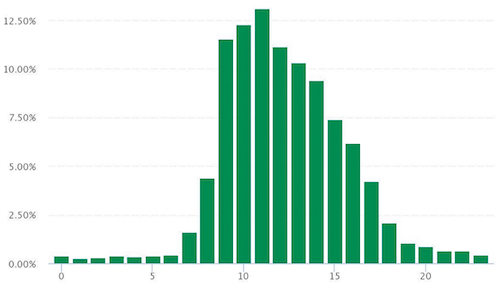 |
| The highest percentage of pitches are opened by journalists between 10-11 a.m. |
According to the Propel study, the pitch categories that resulted in the most responses were business and industrial (4.17 percent), society (3.56 percent), art and entertainment (3.37 percent), food and drink (3.27 percent), finance (3.11 percent) and technology and computing (2.74 percent).
Finally, the study found that PR pros send the highest percentage of pitches to the press at around 9 a.m. However, the study also discovered that media pros actually open a majority of the pitches they receive a little later, at around 11 a.m. The vast majority of these pitch opens are concentrated in the first half of the day, before 1 p.m., and most journalists will open a pitch within the first 30 minutes after receiving it. More than a third (35 percent) open pitches within a minute after it arrives in their inbox.
Propel’s latest “Media Barometer” study was based on an analysis of more than 1.2 million pitches to journalists from March 2020-March 2021.

 Trump Media & Technology Group today reported a $58.2M net loss on $4.1M in 2023 revenues, a disclosure that drove its stock price down 22.6 percent to $47.96.
 Barry Pollack, an attorney at Wall Street’s Harris St. Laurent & Wechsler, has registered Julian Assange as a client with the Justice Dept. “out of an abundance of caution.”
 Paramount Global to slash 800 jobs in what chief executive Bob Bakish calls part of an effort to “return the company to earnings growth"... Rolling Stone editor-in-chief Noah Shachtman is exiting at the end of the month due to disagreements with chief executive Gus Wenner over the direction the magazine is taking... The New York Times broke the $1 billion barrier in annual revenue from digital subscriptions in 2023... Press Forward is investing more than $500 million to strengthen local newsrooms.
 The majority of news articles are read within the first three days of publication, according to a recent report.
 The Los Angeles Times gives pink slips to 115 people or 20 percent of its newsroom staff... TIME is also laying off about 30 employees, which is approximately 15 percent of its editorial staff... The Baltimore Banner, which was launched by Stewart Bainum in 2022 after he failed to buy the Baltimore Sun, added 500 subscribers per day in the three days following Sinclair Broadcast Group's deal to purchase the Sun.


 Have a comment? Send it to
Aug. 4, 2021, by Joe Honick
These data make sense but also challenge the advisories elsewhere in these pages that have counseled good old media relationships to stimulte attention to pitches that work.