
 |
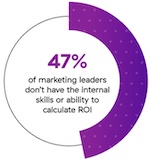
While eight out of 10 marketers say that they are under pressure to prove marketing ROI, almost half (47 percent) admit they don’t have the skills or ability necessary to calculate it, according to a new study conducted by Propeller Insights for marketing performance management company Allocadia.
The study asked more than 250 marketing executives, directors and managers about the status of ROI in their organizations.
One big problem cited is that marketers often do not trust their own data. A majority (61 percent) of those surveyed said that they are not confident in that data, and as a result, they don’t incorporate ROI into their decision-making.
That may account for why many marketers only measure ROI infrequently. Just 42 percent of respondents said they measure ROI monthly, and over 20 percent said they let at least six months go by between measurements.
However, those surveyed said that ROI remains the most critical measurement of assessing the effectiveness of marketing efforts, with 96 percent indicating that they use it. Because of that, improving ROI is a major concern, with 65 percent saying that has been a major focus for them over the past year.
Communicating the importance of ROI across all departments of a company is also seen as a challenge. More than four in 10 respondents (43 percent) say that marketing leaders are not aligned with finance and sales when it comes to ROI.
In addition, some respondents also said they didn’t have access to the budgets or budget decisions that they need to calculate the return on any of their marketing activities.
The report stresses that sharing that information is key to marketing success. “If finance doesn’t trust marketing’s version of ROI,” it notes, “they won’t be willing to grant any budget increases and spending will come under even further scrutiny.”
All of this comes as 84 percent of those surveyed agreed that marketing has grown in importance over the past year.
 Almost two-thirds of the chief communications officers (65.9 percent) surveyed in a new study from Page say that the scope of their job has expanded over the past two years.
 Ask any practitioner or academic, and they’ll tell you that not only is public relations one of the least understood professions in the world, but it also has a lingering odor about it, a stigma, a bad reputation. This has, and will continue to be, a problem for the field. But have you ever asked yourself why, and when, these anxieties about PR became widespread, and if, or how, they may be justified?
 Zara is the most recommended brand in the U.S., according to a new survey conducted by research data and analytics group YouGov.
 In a healthcare environment suffering from what often seems like too much information, doctors have become just one item on a menu of patient choices—and not always the most significant one, according to a new study from Edelman and the Yale School of Public Health.
 Americans spent more than $174 billion on branded merchandise in 2025, according to a newly released study from Promotional Products Association International—accounting for 51 percent of global spending in the industry.


