
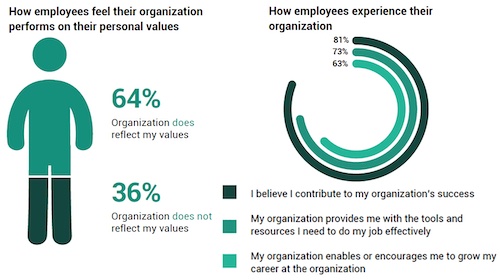
About two-thirds (64 percent) of employees think that the organization they work for reflects their values, according to a new survey from The Harris Poll and employee activation agency Integral, resulting in benefits for employers.
The study found that employees who had a clear sense of their organization’s values were more likely to have a positive view of that organization, a view that translates to an increased likelihood they will take beneficial action on behalf of their employers.
Pluses of an alignment between employee values and those of the companies they work for include an increased sense of loyalty and a greater likelihood that those employees will become online advocates for their organization.
 |
The price of a disconnect between employee values and those of the companies they work for was noted as well. Employees who feel that their organization performs poorly in areas that are important to them are more likely to change jobs.
However, there is less agreement on the value of sharing political views in the workplace. Less than half (48 percent) said that “people should have the ability to express their political views in the workplace,” with slightly more (51 percent) saying that they are comfortable sharing their own political views at work.
Employees from families with children placed a greater emphasis on their organization’s values than did those from those without kids. While 87 percent of those from households with children thought their employer should take positive action on data privacy, only 65 percent of those without kids agreed. Similar gaps exist when it comes to such issues as abortion, climate change, immigration and LGBTQ rights.
The study’s authors suggest that organizations “create formal and informal roads to help employees share their positive energy and mindsets to communicate, influence, and reinforce aligned values.”
Over 2,000 employed people were surveyed for the study by The Harris Poll in mid-summer 2021.

 Employees at U.S. companies are experiencing high levels of burnout, but managers are lagging behind when it comes to their awareness of the problem
 Brand has a powerful effect on a company’s valuation, but the level of brand understanding in the investment community leaves a lot to be desired, according to a new study from Brodeur Partners, Interbrand and NewtonX.
 AI may still be viewed with a wary eye by most media pros, but its use is growing, according to a new study from Muck Rack.
 A new study from Walker Sands says that some marketers have been putting the cart before the horse when it comes to the relationship between marketing channels and business outcomes.
 Thought leadership can make made B2B brands more "powerful and attractive to buyers," according to Edelman report.


 Have a comment? Send it to
Sep. 24, 2021, by Joe Honick
Assuming the reliability of this study and its applicability across geographical boundaries, it could have greater importance than obvious at first glance. For example, other surveys in places like Texas and other "red" states might suggest corporate politics not much online with employees. The same for other parts of the country. It would seem useful for those conducting such research to extend both the questioning and regional analysis as well.