
 |
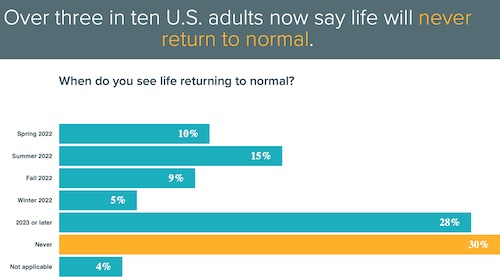
Three out of 10 Americans say that the impact of COVID on day-to-day life will be permanent, according to a new survey conducted by insurtech company HealthCareInsider.
When asked when they thought that life would return to normal, 39 percent said they thought it would happen by the end of 2022, 28 percent thought it would take until 2023 or later and 30 percent don’t see it ever happening.
The level of pessimism has grown since the last edition of the company’s COVID-19 attitudes study at the end of 2020. In that survey, 61 percent of respondents said they thought that things would get back to normal at some point during 2021.
Nearly two-thirds (64 percent) said they have increased their health precautions due to the Omicron variant, limiting such activities as holiday travel and family gatherings.
 |
However, there is a growing belief that vaccines will play a major role in ending the pandemic. While 51 percent of respondents in last year’s survey said that a COVID-19 vaccine would help end the pandemic, that number rose to 61 percent in the new survey.
Comfort levels vary considerably when it comes to resuming various activities. More than half of respondents say that they’re already comfortable shopping indoors (61 percent) or dining and drinking indoors (52 percent), while far fewer are comfortable working out in a gym (33 percent), not wearing a mask in public (32 percent) or attending a concert or sporting event (29 percent).
The desire to travel has also been hit hard, with only 34 percent saying they feel ready to travel now. But the long-term view is far more positive, with only five percent saying they don’t think they’ll ever be comfortable with traveling again.
Travel also tops the list of what respondents said they were most looking forward to after the pandemic is over, with 25 percent choosing it. Other popular choices were not wearing a mask (22 percent) and family gatherings (15 percent).
HealthCareInsider’s study was conducted via a SurveyMonkey Audience on Dec. 13, among a national sample of 1,183 U.S. adults aged 18+.

 Consumers who once demanded convenience now require consistent, multi-channel experiences that cater to them at every point. Brands must have a clear, audience-appropriate, and channel-specific voice across all platforms.
 Employees at U.S. companies are experiencing high levels of burnout, but managers are lagging behind when it comes to their awareness of the problem
 Brand has a powerful effect on a company’s valuation, but the level of brand understanding in the investment community leaves a lot to be desired, according to a new study from Brodeur Partners, Interbrand and NewtonX.
 AI may still be viewed with a wary eye by most media pros, but its use is growing, according to a new study from Muck Rack.
 A new study from Walker Sands says that some marketers have been putting the cart before the horse when it comes to the relationship between marketing channels and business outcomes.

 Have a comment? Send it to
Jan. 16, 2022, by Joe Honick
By now, what we have read, heard and watched on television are tons of surveys made of any number of uninformed but either frightened or wrongly informed audiences or interviewees. What all those people THINK or FEAR only tell us is that there are a lot of people upset, not what would help them feel more confident or knowledgeable. What we also have are too many surveys that confuse the communications businesses as well. And, finally, what we have are too many politicians who have weaponized the whole situation.
It is probably too late to reverse or even modify how the right wing has turned the whole pandemic affair into how to blame everyone else, especially Biden without using some modicum of intelligence to recall or understand that it was their hero Trump who first mocked it all as a flu recurrence or made promises that confused everyone and never evinced a moment indicating he gave a damn about millions of suffering and lonely patients as the situation grew out of hand.
Worse, people we used to see as moderate thinkers and commentators also have focused on what has not been done in the second and third years of the pandemic, forgetting how it was mishandled from the start.
All of this should be the legitimate challenge for ethical and professional communicators to parse for frightened millions and confused billions around the world Trump could not include in his political march.