
 |
The number of people who view government and media as divisive forces in society grew sharply during the past year, according to Edelman’s 22nd Trust Barometer released today.
Nearly half (48 percent) of respondents living in 24 nations surveyed by Edelman call government a dividing force, compared to 36 percent who view it as a unifying factor.
Media did a little better, chalking up an 11 percent gap between dividing (46 percent) and unifying force (31 percent).
Edelman did not ask the dividing/unifying question in China, Russia and Thailand.
NGOs and businesses reported big increases in the perception that they are unifying forces, according to the Barometer.
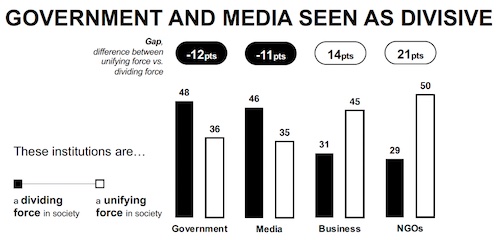 |
Half of those surveyed view NGOs as unifiers vs. 29 percent seeing them as dividers.
Business enjoyed a 14 percent gap between being a unifying (45 percent) or dividing force (31 percent).
More than three-quarters of respondents (76 percent) worry about false information or fake news being used as a weapon.
That was up four points among the Global 27 countries surveyed.
Spain registered the most concern about fake news at 84 percent, while the Netherlands showed the least worry at 63 percent.
China posted a nine percent gain to 80 percent in concern about fake news. Russia was up four points to 78 percent and the US was up two percent to 74 percent.

 Consumers who once demanded convenience now require consistent, multi-channel experiences that cater to them at every point. Brands must have a clear, audience-appropriate, and channel-specific voice across all platforms.
 Employees at U.S. companies are experiencing high levels of burnout, but managers are lagging behind when it comes to their awareness of the problem
 Brand has a powerful effect on a company’s valuation, but the level of brand understanding in the investment community leaves a lot to be desired, according to a new study from Brodeur Partners, Interbrand and NewtonX.
 AI may still be viewed with a wary eye by most media pros, but its use is growing, according to a new study from Muck Rack.
 A new study from Walker Sands says that some marketers have been putting the cart before the horse when it comes to the relationship between marketing channels and business outcomes.

 Have a comment? Send it to
Jan. 18, 2022, by Joe Honick
These are fine, interesting and useful data to find out. BUT where is the "therefore" as to either fix, use or otherwise make practical use of the information that probably surprises few? I would add that the professional PR operations "serving" the massively financed political parties and individuals have added as much fuel to these fires as anyone....the BIG LIE about the alleged Trump comical election could not have been out there in the media otherwise.
Mirrors are for reflection.