
 |
Journalists opened email pitches far less often in 2021 than they did in 2020, according to a new report issued by PR software company Propel.
According to the Q1 2022 Propel Media Barometer, open rates dropped from 38.81 percent in 2020 to 28.45 percent last year, a decline of 37 percent. Response rates saw a similar drop, dipping from 5.21 percent in 2020 to 3.53 percent in 2021.
One possible reason for the slide? Artificial intelligence. “Journalists and news outlets at large became frustrated and concerned that pitches are becoming more and more automated and distributed to inappropriately targeted journalists,” the report says.
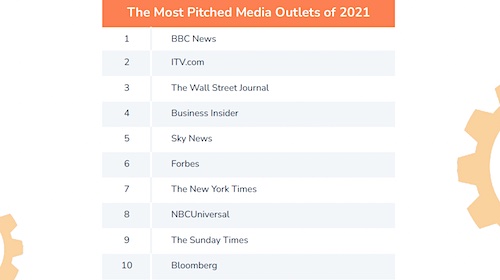
The media outlet with the highest open rate was the Wall Street Journal, where an average of 70.04 percent of pitches were opened. The New York Times was close behind at 66.48 percent, and Business Insider came in third at 49.05 percent.
The best average response rate came from Forbes (4.67 percent), with the WSJ coming in second (3.28 percent).
 |
Propel’s survey also named the most popular topics across the 1.4 million pitches that the platform sent to journalists last year. Business and industrial came out on top (13.83 percent), followed by tech and computing (11.78 percent), health and fitness (9.81 percent) and art and entertainment (9.38 percent).
When it comes to response rate to those pitches, Real Estate did the best (4.46 percent), with business and industrial (4.12 percent) and tech and computing (4.09 percent) coming next.
Going against the prevailing wisdom that Fridays are a bad day to send out pitches, the report found that the last day of the workweek doesn’t really deserve its bad rap. “Friday pitching is absolutely worth a shot,” it says, “as this is the day with the lowest pitch volume and highest relative open rate.”

 Brand has a powerful effect on a company’s valuation, but the level of brand understanding in the investment community leaves a lot to be desired, according to a new study from Brodeur Partners, Interbrand and NewtonX.
 AI may still be viewed with a wary eye by most media pros, but its use is growing, according to a new study from Muck Rack.
 A new study from Walker Sands says that some marketers have been putting the cart before the horse when it comes to the relationship between marketing channels and business outcomes.
 Thought leadership can make made B2B brands more "powerful and attractive to buyers," according to Edelman report.
 The deadline for O'Dwyer's 2024 rankings of PR firms, a benchmark study of the growth of the industry annually since 1970, is Mon., Mar. 11, 2024.


 Have a comment? Send it to
No comments have been submitted for this story yet.