
 |
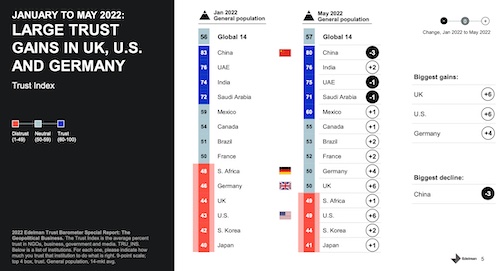
Trust in western democracies is on the rise due to their robust response to Russia’s invasion of Ukraine, according to a special geopolitical report of Edelman’s Trust Barometer released today.
The US and UK showed the largest trust gains (six percent) since January. Germany was up four percent and France advanced two percent in the poll of 14,000 people.
China showed the biggest drop in trust (three percent) among the 14 nations polled. Saudi Arabia and the UAE were the only other decliners. They each dipped one percent.
The Barometer found solid trust gains of 31 points for companies that ended operations in Russia due to the invasion.
 |
Those maintaining businesses there risk a trust loss of 38 points. Almost half (47 percent) of respondents have started to buy or stopped buying a brand due to a company’s response to Ukraine.
Almost six in ten (59 percent) of respondents want CEOs to add geopolitical responsibilities to the corporate agenda.
Nearly all respondents (95 percent) say they want companies to take actions in response to an unprovoked invasion.
CEOs also should proactively curtail business activities in countries that commit human rights abuses rather than wait for governments to impose sanctions (64 percent).
CEOs should exit countries that threaten our national security (62 percent).

 Consumers who once demanded convenience now require consistent, multi-channel experiences that cater to them at every point. Brands must have a clear, audience-appropriate, and channel-specific voice across all platforms.
 Employees at U.S. companies are experiencing high levels of burnout, but managers are lagging behind when it comes to their awareness of the problem
 Brand has a powerful effect on a company’s valuation, but the level of brand understanding in the investment community leaves a lot to be desired, according to a new study from Brodeur Partners, Interbrand and NewtonX.
 AI may still be viewed with a wary eye by most media pros, but its use is growing, according to a new study from Muck Rack.
 A new study from Walker Sands says that some marketers have been putting the cart before the horse when it comes to the relationship between marketing channels and business outcomes.


 Have a comment? Send it to
May 23, 2022, by Joe Honick
These data should also be seen as a major advance for Joe Biden's courageous efforts in the face of wretched political enemies to bring together these western nations. Dems should not lose milliseconds in selling these realities as Putin declares Trump his favorite "boy" while forbidding 963 other Americans from entering Russia for life. No doubt the list-maker will soon add Rupe Murdoch and his favorite imitation journalists, Hannity and Carlson. We can also expect the trio of Graham-Cruz-Jordan to assert personal disappointment at not being included as invitees as well.