
 |
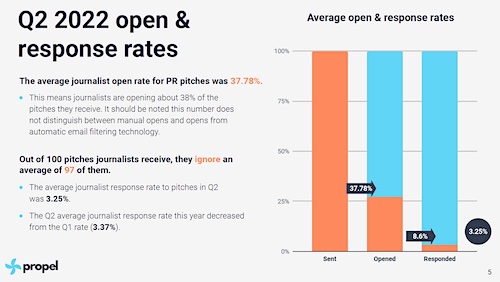
Out of every 100 pitches that get sent to journalists, only about three manage to snag a response, according to the Q3 2022 Propel Media Barometer.
That number continues to slide, going from 3.7 percent of pitches sent in Q2 2021 to 3.25 percent in Q2 this year—a drop of 12 percent.
Most pitches, Propel’s study finds, don’t even get opened. Between manual opens and opens from automatic email filtering technology, the open rate for pitches sits at about 38 percent. Even after a pitch is opened, the likelihood of it drawing a response is only 8.6 percent.
In addition, journalists seem to be making their decisions on whether or not to respond to a pitch rather quickly. The Barometer says that nearly 20 percent of responses come within 10 minutes of a journalist receiving a pitch. Almost 60 percent of responses are received within four hours, and around two-thirds (66.20 percent) come the day the pitch is made.
 |
Because of that, a strong first impression is a big factor in the success of any pitch.
For subject lines, that means short is better—from one to five words long. Pitches of that length had a 4.03 percent response rate, while those with subject lines of 16 words or more only attracted responses 2.03 percent of the time.
Pitch leads did best (a 3.96 percent response rate) when they ran between 50 and 79 words. For the overall length of a pitch, those with 50 to 149 words did the best, with a 9.25 percent response rate.
Adding an emoji to a pitch did not seem to greatly affect response rates (2.88 percent without, 3.05 percent with), but since only about one percent of pitches use emojis, the sample size on that is somewhat limited.
Embedded links can help, but the Barometer’s advice is to use them judiciously. While pitches with two or three embedded links had a response rate of 3.8 percent, once the number of links hits four, the rate drops to 2.51 percent.
The day of the week on which you send a pitch can also contribute to its success factor. Most pitches examined were sent on Tuesday (24.78 percent), and that day also had the highest open rate (24.35 percent). The weekend, not surprisingly, doesn’t present much in the way of opportunity. Less than one percent of pitches were sent on Saturday or Sunday, and response rates were equally low.
Topics that garnered the best response rates were tech & computing, food & drink and business & industrial.
Propel’s study analyzed approximately 500,000 pitches sent during Q1 2022.

 Brand has a powerful effect on a company’s valuation, but the level of brand understanding in the investment community leaves a lot to be desired, according to a new study from Brodeur Partners, Interbrand and NewtonX.
 AI may still be viewed with a wary eye by most media pros, but its use is growing, according to a new study from Muck Rack.
 A new study from Walker Sands says that some marketers have been putting the cart before the horse when it comes to the relationship between marketing channels and business outcomes.
 Thought leadership can make made B2B brands more "powerful and attractive to buyers," according to Edelman report.
 The deadline for O'Dwyer's 2024 rankings of PR firms, a benchmark study of the growth of the industry annually since 1970, is Mon., Mar. 11, 2024.


 Have a comment? Send it to
Jul. 13, 2022, by Joe Honick
As usual, Steve does a damned good reporting job on a worthwhile topic. What might be useful to think about is how readily we call reporters "journalists" and wondering as well how beat reporters act on pitches or any biases they may have. Also worth an extension of this study might be some instructive data for contacting featured columnists whose words carry weight.
A realistic aspect is the ongoing reduction of newsrooms by generally right wing folks like Alden Global, Murdoch and others assaulting free reportage and commentary.