
 |
Large businesses have a major role to play in shaping the future of the United States, according to a new study from FTI Consulting, and stakeholders expect the CEOs of those businesses to take their responsibility to the country seriously.
FTI surveyed institutional investors and professional employees and found a considerable amount of consensus on the importance of corporate responsibility.
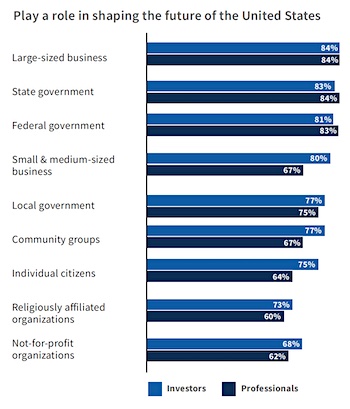
More than 84 percent of both investors and professionals surveyed agreed that large-sized businesses help to shape the country’s future, just about even with state government (83 percent of investors, 84 percent of professionals) and federal government (81 percent of investors, 83 percent of professionals).
Respondents also said that corporate CEOs should cooperate with government authorities during moments of national crisis or major social change (85 percent of investors, 81 percent of professionals).
 |
However, the opinions of professionals regarding CEOs' involvement in political issues were a little more variable. Only 38 percent of those surveyed said they thought CEOs should engage in politics. That number was a little higher for respondents who were Millennials or Democrats (both registering at 52 percent).
Many respondents also said they want to be on the same page as the leadership of the company where they work. Almost six out of 10 investors said they would not work for a CEO whose social or political views were at odds with their own. For professionals, that number is not nearly as high (38 percent), but it rises to 50 percent for those that are Democrats and 51 percent for Millennials.
There is also general agreement that CEOs should do their homework to make sure any political stances they take are in line with the corporate values of their company (86 percent of investors, 79 percent of professionals) and the opinions of their customers (84 percent of both groups).
Investors and professionals differed on what topics were the most important ones on which they thought CEOs should speak out. For investors, the top three are the US economy, data security and environmental issues. Professionals prioritized healthcare costs, ethical business practices and minimum wage.
FTI Consulting’s survey polled 1,012 employed professionals from companies with more than 250 employees and 253 institutional investors.

 Consumers who once demanded convenience now require consistent, multi-channel experiences that cater to them at every point. Brands must have a clear, audience-appropriate, and channel-specific voice across all platforms.
 Employees at U.S. companies are experiencing high levels of burnout, but managers are lagging behind when it comes to their awareness of the problem
 Brand has a powerful effect on a company’s valuation, but the level of brand understanding in the investment community leaves a lot to be desired, according to a new study from Brodeur Partners, Interbrand and NewtonX.
 AI may still be viewed with a wary eye by most media pros, but its use is growing, according to a new study from Muck Rack.
 A new study from Walker Sands says that some marketers have been putting the cart before the horse when it comes to the relationship between marketing channels and business outcomes.

 Have a comment? Send it to
Jul. 21, 2022, by Bill Huey, Strategic Communications
t would be interesting to know when this survey was taken, because it seems to me that ESG and all this "soft" stuff are for good times, and we are in hard times, with harder times on the horizon. Ford is laying off 8,000 workers, and layoffs usually mean recession.
In the meantime, I see CEOs doing the same things CEOs have traditionally spent most of their time on, i.e., eliminating competition; avoiding taxes; and escaping regulation.