
 |
Business is now seen as more trustworthy than NGOs, government or the media, according to the newly released 2023 Edelman Trust Barometer.
Edelman’s study, which surveyed more than 32,000 people in 28 countries, found that in an increasingly polarized world, business is far outperforming governments as regards trust levels. Across all the countries surveyed, business is deemed trustworthy by 62 percent of respondents, vs. 51 percent for governments.
Business is also seen as considerably less likely to be a source of “false or misleading information,” with only 30 percent of respondents giving it low marks in that category, as opposed to the 46 percent who say the same about governments.
Overall trust levels don’t seem to be consistent for all segments in most countries. For “high income” (top 25 percent) US respondents, Edelman’s Trust Index sits at 63 percent, compared to 40 percent for the “low income” (bottom 25 percent) respondents.
Economic optimism is on the decline across the board in the study. Out of the 28 countries surveyed, 24 recorded all-time lows in that category. When asked if they agreed that “My family and I will be better off in five years,” only 40 percent said yes—down 10 percent from last year’s survey.
 |
Rising levels of political polarization are affecting consumers as well. The responses from six countries (US, Spain, Sweden, South Africa, Argentina and Colombia) show them as “highly polarized,” with another nine “in danger of severe polarization.”
That sense of social and political polarization can make the role that businesses (especially employers) play more important. While survey participants who said that political divisions in their country are “entrenched” showed the lowest trust levels across all categories, their level of trust in business held up fairly well—sitting at 69 percent, as opposed to 49 percent for NGOs, 34 percent for media and 27 percent for government.
The Trust Barometer offers some suggestions for how businesses can make the most of the relatively high levels of trust that people have in them.
Almost seven out of ten respondents (69 percent) agreed that “brands celebrating what brings us together and emphasizing our common interest would strengthen the social fabric.” Nearly as many (64 percent) said that brands should “support politicians and media that build consensus and cooperation.”
There is also a general feeling that brands should take a stand against misinformation, with 71 percent of respondents saying that brands should “pull advertising money from platforms that spread misinformation.”
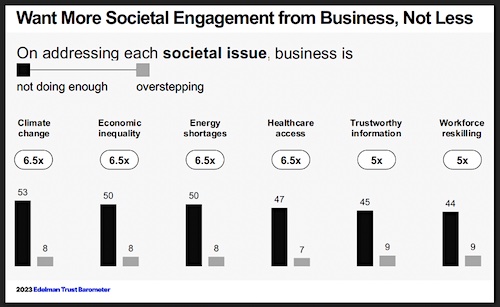
The study indicated that respondents actually want more societal engagement from business around such issues as climate change (53 percent), economic inequality and energy shortages (both 50 percent), But that engagement carries risks with in, according to Edelman CEO Richard Edelman.
“The increased perception of business as ethical brings with it higher than ever expectations of CEOs to be a leading voice on social issues,” Edelman said. “But business must tread carefully—more than half (52 percent) of our respondents do not believe business can avoid being politicized when it addresses contentious societal issues.”

 Consumers who once demanded convenience now require consistent, multi-channel experiences that cater to them at every point. Brands must have a clear, audience-appropriate, and channel-specific voice across all platforms.
 Employees at U.S. companies are experiencing high levels of burnout, but managers are lagging behind when it comes to their awareness of the problem
 Brand has a powerful effect on a company’s valuation, but the level of brand understanding in the investment community leaves a lot to be desired, according to a new study from Brodeur Partners, Interbrand and NewtonX.
 AI may still be viewed with a wary eye by most media pros, but its use is growing, according to a new study from Muck Rack.
 A new study from Walker Sands says that some marketers have been putting the cart before the horse when it comes to the relationship between marketing channels and business outcomes.

 Have a comment? Send it to
No comments have been submitted for this story yet.