
 |
An increasing number of both employees and investors say they want CEOs to be accessible—and fewer of them put a high priority on empathy. So says a new report from FTI Consulting.
FTI’s “CEO Leadership Redefined 2023” looked at the qualities that stakeholders want to see from CEOs. The study polled 800 full-time employees working for large companies, 250 institutional investors and 200 D.C. policy influencers.
More than a quarter (28 percent) of employees surveyed said that accessibility was one of the top three attributes that a CEO should have—up 13 percent from a study conducted in 2021. And while accessibility was not as important for investors, it still was mentioned as a major priority by 16 percent of them, an increase from 12 percent in 2021.
The spotlight previously placed on empathy faded, however. It was cited by only 21 percent of employees surveyed, as opposed to 27 percent in the 2021 edition of the report. For investors, that number dropped to 13 percent from 18 percent.
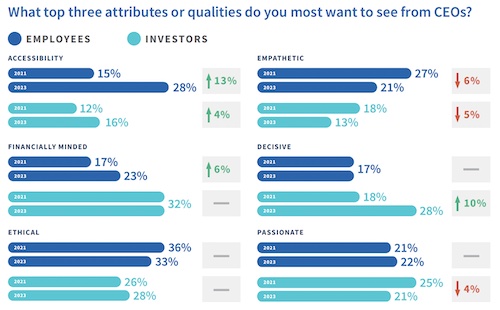 |
Although the top attribute valued by employees was being ethical (cited by 33 percent), its appeal still slid slightly from 2021’s 36 percent. For investors, the appeal of being ethical went up slightly, from 26 percent in 2021 to 28 percent this year.
Perhaps not surprisingly, being “financially minded” was the top quality valued by the investors surveyed, staying steady at 32 percent from 2021’s mark. Employees did not value that attribute quite as highly, though it still rose to 23 percent from 17 percent in 2021.
But while the bottom line is the most rapidly growing concern in the post-pandemic environment, the concern for employee welfare Is still a major factor. The number of employees who said that “strengthening financial performance/profitability” should be a CEO’s biggest priority took a big jump from 13 percent in 2021 to 32 percent this year, while investors gave it even greater emphasis—up to 42 percent from 20 percent in the previous survey.
However, the appeal of “strengthening health and wellbeing” also rose, with 38 percent of employees placing it first on a CEO’s priority list, up from 34 percent in 2021. For investors, the hike was more pronounced, going from 14 percent in 2021 to 32 percent this year.
Survey respondents across the board also said that CEOs need to temper their responses to social issues with the financial priorities of their company. Almost seven in 10 employees (68 percent) said that CEOs should only engage on issues that directly affect their company, while 79 percent of the investors and 95 percent of the D.C policy influencers agreed.
FTI Consulting’s digital and insights team conducted the “CEO Leadership Redefined 2023” from Jan. 8 to Feb. 1.

 Brand has a powerful effect on a company’s valuation, but the level of brand understanding in the investment community leaves a lot to be desired, according to a new study from Brodeur Partners, Interbrand and NewtonX.
 AI may still be viewed with a wary eye by most media pros, but its use is growing, according to a new study from Muck Rack.
 A new study from Walker Sands says that some marketers have been putting the cart before the horse when it comes to the relationship between marketing channels and business outcomes.
 Thought leadership can make made B2B brands more "powerful and attractive to buyers," according to Edelman report.
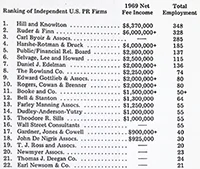 The deadline for O'Dwyer's 2024 rankings of PR firms, a benchmark study of the growth of the industry annually since 1970, is Mon., Mar. 11, 2024.


 Have a comment? Send it to
No comments have been submitted for this story yet.