
 |
A majority of corporate executives say that businesses have made progress toward addressing racism and racial inequalities, but according to the latest Edelman Trust Barometer Special Report, a lot of the people who report to them do not agree.
Edelman’s report on business and racial justice found that 60 percent of the executives who were polled thought their organizations were making meaningful progress on racial issues. But the level of agreement from middle management (28 percent) and non-managerial employees (18 percent) was far lower.
This comes as the overall level of concern about racism in the US is growing. Almost seven in 10 survey respondents (69 percent) said they were “concerned about systemic racism and racial injustice in this country,” which is up eight percent from Edelman’s April 2022 survey. While that number rises to 84 percent for respondents who said they were Democrats, it drops to 64 percent for independents and 50 percent for Republicans.
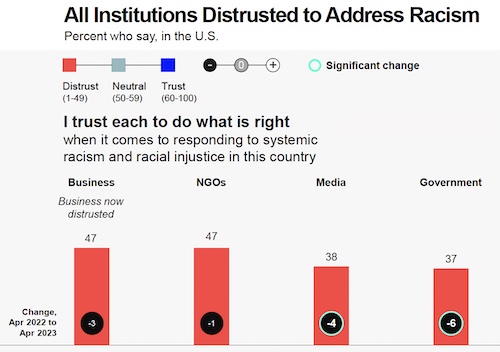 |
In addition, 81 percent of respondents said that the country is divided on racism and how to address it, and more than half (57 percent) think the country has made little to no progress—or that things have gotten worse—in addressing systemic racism.
However, employees who responded to the survey said that businesses can play an important role in bringing about change. DEI initiatives in the workplace were judged to be an effective measure to address racism by 80 percent of them—on par with such government actions as requiring schools to teach the complete history of people of color (80 percent) and enacting legislation that reforms policing (78 percent).
But the disconnect between the executive suite and the workplace could throw a wrench into those possibilities. Only a quarter (25 percent) of all employees said they trust their company CEO to tell the truth about racism and DEI matters in the organization. Once again, executives were more positive than other employees, with 56 percent saying they trust the CEO on these issues, with mid-level employees lagging behind at 24 percent and associates only showing a trust level of 15 percent.
And while executives are less likely than associates to see the benefits of a diverse workforce, the report says that companies who make progress toward racial equality can be expected to see several other benefits. That progress is tied to a 39 percent jump in loyalty, a 36 percent jump in the likelihood of employees to recommend their organization to others and a 34 percent hike in the level of commitment to helping their employer succeed.
The Edelman Trust Barometer report was conducted from April 4-12.

 Brand has a powerful effect on a company’s valuation, but the level of brand understanding in the investment community leaves a lot to be desired, according to a new study from Brodeur Partners, Interbrand and NewtonX.
 AI may still be viewed with a wary eye by most media pros, but its use is growing, according to a new study from Muck Rack.
 A new study from Walker Sands says that some marketers have been putting the cart before the horse when it comes to the relationship between marketing channels and business outcomes.
 Thought leadership can make made B2B brands more "powerful and attractive to buyers," according to Edelman report.
 The deadline for O'Dwyer's 2024 rankings of PR firms, a benchmark study of the growth of the industry annually since 1970, is Mon., Mar. 11, 2024.


 Have a comment? Send it to
No comments have been submitted for this story yet.