
For months, the news media has dedicated an extraordinary amount of attention to generative artificial intelligence tools such as ChatGPT, Google Bard and Microsoft Bing, as well as to fears regarding how that technology threatens to upend—if not completely replace—some sectors of the workforce.
As it turns out, those fears may be justified, as many small business owners now seem confident that they’ll be able to leverage AI technology for an increasing number of applications traditionally handled by employees, according to recent findings from accounting software company FreshBooks.
 |
FreshBooks’ survey, which sought to measure AI’s current and future usage in one of the most vital sectors of the U.S. economy, discovered that 44 percent of business owners said they expect to hire fewer people in the future due to the capabilities provided by generative AI.
More than half (60 percent) said they think AI technology will dramatically change their business within the next five years. Two out of three business owners surveyed (66 percent) said they plan to adopt generative AI for their business in some capacity within the next year.
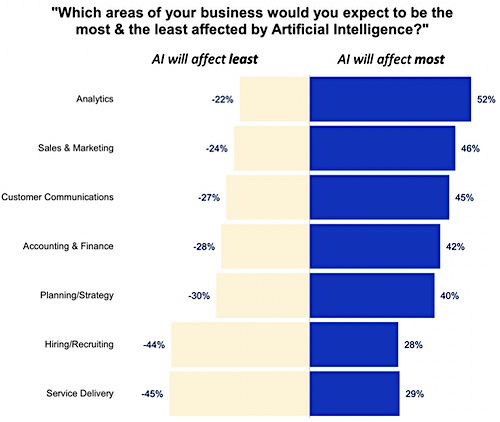
When it comes to which areas of their business these owners expect to see the most impact from AI, analytics and finance came in at first place (52 percent), followed by sales and marketing (46 percent), customer communications (45 percent), accounting and finance (42 percent) and planning and strategy (40 percent). Bottoming out the list were service delivery (29 percent) and hiring and recruiting (28 percent).
On the other hand, small business owners don’t seem particularly convinced that AI technology will replace the jobs of their employees anytime soon. Two-thirds of business owners surveyed said they don’t think AI will replace them or their staff. The survey also found that the smaller the business, the less likely small business owners think AI will replace employees.
The report additionally found that nearly half (46 percent) of small business owners admitted they aren’t currently clear on how AI could benefit their business. Only 25 percent said they’re currently using or testing generative AI tools. And 16 percent admitted they don’t use generative AI technology because they’re not a “technical person.”
Finally, regardless of how and to what extent small business owners foresee using AI tools in the course of running their business, an overwhelming majority of respondents (80 percent) admitted they’re concerned about privacy, ethical and intellectual property issues associated with this technology.
FreshBooks’ “AI Report” was based on an online survey of 1000 U.S.- and Canada-based small business owners across various industries. The survey was conducted in-house in May.

 Thanks to advances in AI, social media has now taken a leading role in providing customer support services for brands, with adoption achieving noted fanfare among Gen Z consumers.
 Why universities must offer Communications Engineering degrees in the AI-driven world.
 The Windy City is bullish on AI, according to a recent survey conducted by the Communications Leaders of Chicago in conjunction with DePaul University’s College of Communication.
 The emergence of generative artificial intelligence (Gen AI) technology is a curveball that has the potential to significantly disrupt and erode voter trust in the media and governmental leadership.
 The process of conducting searches is being transformed by generative AI, which is now embedded within search engines such as Bing, Perplexity, and Google's Search Generative Experience.


 Have a comment? Send it to
No comments have been submitted for this story yet.