
Crisis expert Eric Dezenhall says companies have three options when Trump gets them in the cross hairs on Twitter. The first is to capitulate.
|
|
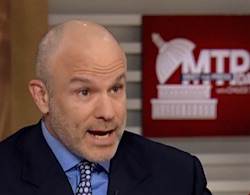 Dezenhall on Meet The Press Daily with Chuck Todd.
In recent weeks both Ford and Carrier have chosen this option. By doing so, they gave Trump a win, solved the problem and were out of the news cycle.
“You sir, in your brilliance, wisdom and handsomeness are right, we are going to do what you want us to do,” is the stance Dezenhall said companies must sometimes take.
The next option is to seek to minimize the damage.
When Trump went after the pharmaceutical companies for price gouging, there was no way they could capitulate. “How could hundreds of drug companies come together inside of minutes and redo pricing policy on thousands of different drugs?” Dezenhall asks.
It’s impossible, so the only recourse is to minimize the situation by issuing a vanilla statement saying they look forward to a constructive dialog on the issue, Dezenhall explains.
The fact that Trump tweets so much is good and bad at the same time. “Trump tweets a lot but the good news is he tweets about a lot of stuff and you never know when your issue will move out of the news,” Dezenhall says. “Better to be boring.”
Crisis management is 30 years behind in always telling clients to respond immediately, Dezenhall stresses. “Sometimes the problem just goes away quickly.”
The third option is to fight back.
Dezenhall has observed that most companies are terrified of fighting back because they’re only good at behind-the-scenes work and there’s usually not one person trained and willing to get on TV because the person most likely will lose their job.
“What if Trump does something permanently onerous to a business that you must go on TV and fight?” Dezenhall asks. He explains that you’re probably going to lose this fight, but sometimes there’s no other choice.
Companies are trying hard to figure out under what conditions they’ll fight back.
“Everyone’s terrified right now,” Dezenhall says.

 There’s a fine line between newsjacking and taking advantage, aka ambulance chasing. Our job as PR professionals is to tread it carefully.
 PR firms need to be mindful of ways their work product may be protected by the attorney-client privilege whenever working with a client’s internal legal team or its external legal counsel.
 Manuel Rocha, former US ambassador and intenational business advisor to LLYC, plans to plead guilty to charges that he was a secret agent for Cuba.
 CEO mentoring is an often-overlooked aspect of why CEOs are able to make good decisions, and sometimes make bad ones—all of which intersects with the role and duties of a board.
  How organizations can anticipate, prepare and respond to crises in an increasingly complex world where a convergent landscape of global challenges, threats and risks seem to arrive at an unrelenting pace.


 Have a comment? Send it to
No comments have been submitted for this story yet.