
News coverage of the COVID-19 pandemic continues to dominate the media cycle, but Americans’ opinions regarding the media’s handling of the outbreak have generally turned more favorable, according to analysis recently released by the Pew Research Center.
Pew’s study found that the number of Americans who currently believe the media exaggerates the risks associated with the outbreak now stands at 48 percent, a decline of 14 percent from Pew’s previous findings in March (62 percent).
Americans’ perceptions regarding whether the media have conveyed the coronavirus’ risks truthfully remain divided, however, and typically that division lies along partisan lines. While only 30 percent of respondents identifying as Democrat or Democrat-leaning currently believe the media has exaggerated the risks of the outbreak (compared to 49 percent in March), the dial hasn’t moved nearly as much for Republicans, 68 percent of whom still believe the media exaggerates the risks of COVID-19 (a drop of only eight percent from the 76 percent of Republican respondents who said this in March).
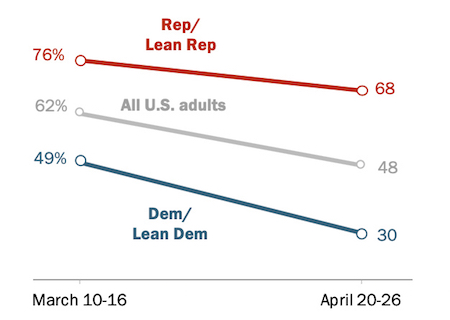 Democrat respondents were more likely to exhibit a favorable change in their views regarding whether the media has exaggerated the risks associated with COVID-19 than Republicans. Democrat respondents were more likely to exhibit a favorable change in their views regarding whether the media has exaggerated the risks associated with COVID-19 than Republicans. |
Overall, Pew’s analysis discovered that Americans approve of the media’s coverage of the pandemic, with more than two-thirds (69 percent) of respondents saying they believe the media have covered the outbreak very well—or at least somewhat well—a number that’s virtually unchanged from previous Pew findings in March (70 percent). More than half (59 percent) additionally said they think the media are providing them with important COVID-19-related information, compared to about a quarter of Americans (24 percent) who disagree. About half of respondents (49 percent) also believe the media’s coverage of COVID-19 has been largely accurate, compared with 24 percent who think it’s been mostly inaccurate.
Once again, however, respondents’ political leanings appear as a clear indicator in influencing their perceptions regarding the media’s accuracy and overall performance in covering the COVID-19 pandemic. While about eight-in-ten Democrat and Democrat-leaning voters think media have covered COVID-19 somewhat or very well, only slightly more than half of Republican and Republican-leaning voters (54 percent) believe this. And while two-thirds of Democrats (66 percent) think the media’s COVID-19 coverage has been largely accurate, less than half that number of Republicans (31 percent) agree.
Pew’s analysis was based on a survey of more than 10,100 U.S. adults drawn from the nonpartisan think tank’s American Trends Panel, a nationally representative list of randomly selected U.S. adults. Data for the report was compiled as part of the nonpartisan think tank’s Election News Pathways project, an ongoing initiative that seeks to understand how Americans are getting their news in the months leading up to the 2020 election. Surveys were conducted online between April 20-26.

 Trump Media & Technology Group today reported a $58.2M net loss on $4.1M in 2023 revenues, a disclosure that drove its stock price down 22.6 percent to $47.96.
 Barry Pollack, an attorney at Wall Street’s Harris St. Laurent & Wechsler, has registered Julian Assange as a client with the Justice Dept. “out of an abundance of caution.”
 Paramount Global to slash 800 jobs in what chief executive Bob Bakish calls part of an effort to “return the company to earnings growth"... Rolling Stone editor-in-chief Noah Shachtman is exiting at the end of the month due to disagreements with chief executive Gus Wenner over the direction the magazine is taking... The New York Times broke the $1 billion barrier in annual revenue from digital subscriptions in 2023... Press Forward is investing more than $500 million to strengthen local newsrooms.
 The majority of news articles are read within the first three days of publication, according to a recent report.
 The Los Angeles Times gives pink slips to 115 people or 20 percent of its newsroom staff... TIME is also laying off about 30 employees, which is approximately 15 percent of its editorial staff... The Baltimore Banner, which was launched by Stewart Bainum in 2022 after he failed to buy the Baltimore Sun, added 500 subscribers per day in the three days following Sinclair Broadcast Group's deal to purchase the Sun.


 Have a comment? Send it to
No comments have been submitted for this story yet.