
Americans identifying as Republican exhibit a marked lack of trust in national news organizations, and one that has been virtually cut in half in the last five years, according to a recent analysis by the Pew Research Center.
Pew’s analysis, which is part of the nonpartisan think tank’s ongoing investigation into the state of news and journalism in the digital age, discovered a gap in trust of national news organizations that is widening among partisan lines.
Overall, nearly six-in-ten Americans (58 percent) claim to have at least some trust in the information they receive from national news organizations. According to Pew, this is the smallest share since 2016 and accounts for a seven-point drop from the 65 percent reported in late 2019.
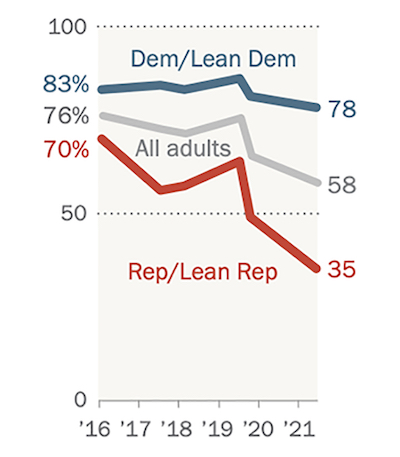 |
| The percentage of U.S. adults who say they have a lot or some trust in the information that comes from national news organizations. |
However, it appears that much of this loss in trust is being driven by sharp trust declines among Republicans. While nearly eight-in-ten Democrats and Democratic-leaning independents (78 percent) claim they have “a lot” or “some” trust in the information they get from national news organizations, only 35 percent of Republicans said the same.
According to Pew, this 43 percentage-point partisan gap is the largest reported at any time that this question has been asked since 2016 and grows even wider—to 53 points—when contrasted between liberal Democrats (83 percent) and conservative Republicans (30 percent).
The Pew analysis also found that the number of Republicans who trust national news organizations is shrinking: The 35 percent of Republicans who said they currently have at least some trust in the national news is half of the 70 percent who said they trusted the media five years ago. Overall, Republicans’ trust in the news has dropped 14 points since just late 2019, where it was gauged at 49 percent. By contrast, Democrats have remained more or less consistent in their trust in the media for the past five years, ranging somewhere between 78 percent and 86 percent.
Only 12 percent of Americans said they have “a lot” of trust in the information that comes from national news organizations.
Pew’s analysis was based on a survey of more than 10,600 U.S. adults drawn from the Center’s American Trends Panel, a nationally representative list of randomly selected respondents. Surveys were conducted between June 14 and June 27.

 Trump Media & Technology Group today reported a $58.2M net loss on $4.1M in 2023 revenues, a disclosure that drove its stock price down 22.6 percent to $47.96.
 Barry Pollack, an attorney at Wall Street’s Harris St. Laurent & Wechsler, has registered Julian Assange as a client with the Justice Dept. “out of an abundance of caution.”
 Paramount Global to slash 800 jobs in what chief executive Bob Bakish calls part of an effort to “return the company to earnings growth"... Rolling Stone editor-in-chief Noah Shachtman is exiting at the end of the month due to disagreements with chief executive Gus Wenner over the direction the magazine is taking... The New York Times broke the $1 billion barrier in annual revenue from digital subscriptions in 2023... Press Forward is investing more than $500 million to strengthen local newsrooms.
 The majority of news articles are read within the first three days of publication, according to a recent report.
 The Los Angeles Times gives pink slips to 115 people or 20 percent of its newsroom staff... TIME is also laying off about 30 employees, which is approximately 15 percent of its editorial staff... The Baltimore Banner, which was launched by Stewart Bainum in 2022 after he failed to buy the Baltimore Sun, added 500 subscribers per day in the three days following Sinclair Broadcast Group's deal to purchase the Sun.


 Have a comment? Send it to
Aug. 31, 2021, by Joe Honick
How could such believers feel differently? What has occurred and is overlooked is that there are tons of money being poured into a wide range of right wing media who likewise are performing powerfully the big lie strategy. These are daily online efforts like those produced by Ben Shapiro and Mike Levin and David Horowitz, and strongly and popularly produced by a guy named Bangino, whose widely read material is not seen by ordinary Facebook participants. Along with these characters is a small army of radio and television loudmouths, some of whom are financed by Rupe Murdoch.
The proliferation of these "media" are no less parts of what get to Americans than what Pew refer to as "national news organizations. The difference is that they are more widespread and better financed than ever before.
It would be good if Pew would check them out as well.