
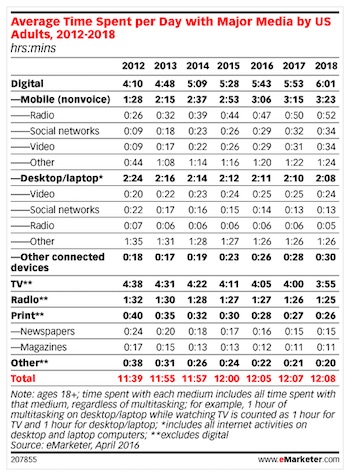
 American adults this year will spend a daily average of about 12 hours and five minutes interacting with media of some variety, according to a new report by digital market research company eMarketer. This includes more than three hours on mobile devices, a little more than two hours on desktop and laptop computers, more than four hours watching television, about an hour-and-a-half listening to radio and a little under a half-hour with print media.
The current average time spent per day with major media accounts for a five-minute increase in total media consumption from 2015, a 10-minute increase from 2014 and a 25-minute increase from 2012. However, eMarketer’s new report indicates that Americans’ rabid media consumption may be slowing, with a ceiling to those gains expected in the years to come.
eMarketer’s new report, “US Time Spent with Media,” shows that American adults’ average time spent per day with all media is expected to see gains of only about two minutes in 2017 and another minute by 2018, revealing total growth time within the next two years of only about 0.1 percent.
Digital media, by far the fastest growing media format — which includes mobile devices, as well as desktop and laptop computers — will continue to see bigger gains than any media category, comprising more than six hours of average daily consumption by 2018. Most of these gains will come from mobile devices and video. Desktop and laptop computers are the only devices in this category expected to slow in usage, losing about one minute of use in 2017 and another two minutes by 2018.
TV, on the other hand, which remains the largest serving of Americans’ daily media diet, will see the biggest loses. That medium, whose usage has been steadily plummeting in recent years — losing between five and ten minutes of daily use per year — will comprise only 3 hours and 55 minutes of Americans' daily media usage in 2018, which is nearly an hour less than the average time Americans spent with the medium in 2012.
Newspaper and magazines, already at the bottom of the media pyramid, by 2018 will comprise only about 15 minutes and 11 minutes of average daily time, respectively. A silver lining for this category is the detail that total print media consumption time is expected to slide by only about a minute in 2017 and another minute in 2018.
Perhaps the most prescient detail of the report is the notion that digital media, by far the most boisterous medium, will see only a modest rise in usage in the coming years, gaining 10 more average daily minutes of use time in 2017 and another eight minutes in 2018.
Even mobile, the digital media category that experienced the largest gains in recent years — jumping from an hour and 28 minutes in 2012 to two hours and 15 minutes the following year — is expected to slow: Americans will spend only nine more minutes interacting with mobile media in 2017 than this year, and only eight more minutes the following year.
A slow-down in growth for the most popular media category, the report notes, signals that Americans may be nearing a saturation point in daily media usage, and that increases in time spent with one media format could be arriving at the expense of time spent with the others.

 Trump Media & Technology Group today reported a $58.2M net loss on $4.1M in 2023 revenues, a disclosure that drove its stock price down 22.6 percent to $47.96.
 Barry Pollack, an attorney at Wall Street’s Harris St. Laurent & Wechsler, has registered Julian Assange as a client with the Justice Dept. “out of an abundance of caution.”
 Paramount Global to slash 800 jobs in what chief executive Bob Bakish calls part of an effort to “return the company to earnings growth"... Rolling Stone editor-in-chief Noah Shachtman is exiting at the end of the month due to disagreements with chief executive Gus Wenner over the direction the magazine is taking... The New York Times broke the $1 billion barrier in annual revenue from digital subscriptions in 2023... Press Forward is investing more than $500 million to strengthen local newsrooms.
 The majority of news articles are read within the first three days of publication, according to a recent report.
 The Los Angeles Times gives pink slips to 115 people or 20 percent of its newsroom staff... TIME is also laying off about 30 employees, which is approximately 15 percent of its editorial staff... The Baltimore Banner, which was launched by Stewart Bainum in 2022 after he failed to buy the Baltimore Sun, added 500 subscribers per day in the three days following Sinclair Broadcast Group's deal to purchase the Sun.


 Have a comment? Send it to
No comments have been submitted for this story yet.