
 |
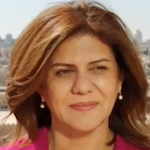
| Shireen Abu Akleh |
Al Jazeera Media Network says Israel’s government is responsible for the May 11 killing of its veteran journalist Shireen Abu Akleh, who was shot while covering an Israel Defense Force raid on a Palestinian refugee camp in Jenin.
The Qatar-based satellite TV company calls on the ”international community to condemn and hold the Israeli occupation forces accountable for their intentional targeting and killing of Shireen,” according to its statement.
Abu Akleh was wearing a blue flak jacket marked “Press” at the time of her murder.
The IDF, which came under heavy fire while conducting its military operation, is investigating the incident and raised the possibility that Abu Akleh was shot by a Palestinian gunman.
Prime minister Naftali Bennett said “there is a considerable chance that armed Palestinians, who were firing wildly, were the ones who brought about the journalist’s unfortunate death.”
Tom Nides, US ambassador to Israel, also called for an investigation of the shooting of Abu Akleh and the injury of at least one other journalist in Jenin.
In a tweet, he identified Abu Akleh as an American and Palestinian journalist.
Abu Akleh, who was 51, was born and raised in Jerusalem in a Christian family. She joined Al Jazeera at its launch in 1997 and "became the face of Palestinian coverge for millions of Arab households," reported CNN.

 There’s a fine line between newsjacking and taking advantage, aka ambulance chasing. Our job as PR professionals is to tread it carefully.
 PR firms need to be mindful of ways their work product may be protected by the attorney-client privilege whenever working with a client’s internal legal team or its external legal counsel.
 Manuel Rocha, former US ambassador and intenational business advisor to LLYC, plans to plead guilty to charges that he was a secret agent for Cuba.
 CEO mentoring is an often-overlooked aspect of why CEOs are able to make good decisions, and sometimes make bad ones—all of which intersects with the role and duties of a board.
  How organizations can anticipate, prepare and respond to crises in an increasingly complex world where a convergent landscape of global challenges, threats and risks seem to arrive at an unrelenting pace.


 Have a comment? Send it to
May 11, 2022, by Joe Honick
Every time a courageous member of the press dies or is wounded covering dangerous stories, the tragedy is multiplied by the coverage virtually around the world. Similar events are occurring right now in Ukraine. But reportage of the Palestinian-Israel forever conflict is hardly ever balanced, however the good intentions of the finest press, one of which Al Jazeera has been touted to be.
Thus the death of Shireen Abu Akleh gets the major billing it should, as was the case with the slaughter of Jamal Khashoggi but whose alleged Saudi killers got confused even in the US where we could not muster blame, only miscellaneous allegations.
In the Al Jazeera case, the press is specifying the blame and the story has gone worldwide understandably. Investigations are being called for by international diplomats. Forgotten even by Al Jazeera's best are just about all the recent murders of Israeli citizens by axe wielding Palestinians and an array of increased assaults on Jews in numerous countries, none stimulating "investigations" by world diplomats. Such for years has been the cases with long forgotten murders of Israeli Olympic athletes and coaches, the murders of Israeli school children in Ma'alot and multi-nation attempts at destroying the Jewish State.
Better reporting of those events would not and could not counterweight the death of Abu Akleh at all. A check of media coverage indicates little balance for this sad event as well.