
 |
As the number of journalists continues to decline, the role of sponsored content is becoming increasingly important, according to a new report from V2 Communications and independent research firm Researchscape.
A “small, informal poll” of the V2 network found that 85 percent of those PR pros think that sponsored content needs to be a part of the media mix. And Researchscape’s online study of over 1,400 US consumers showed a widespread willingness on the part of consumers to pay attention to—and act on—sponsored content.
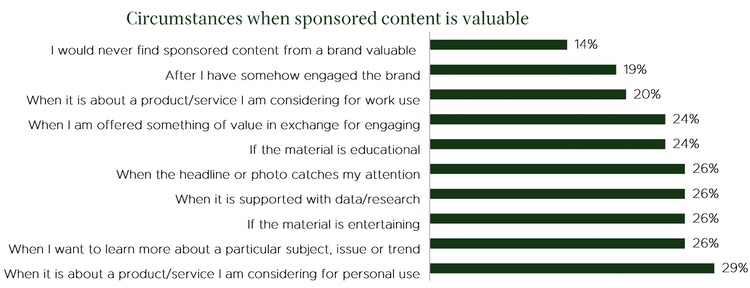
Only 14 percent of those surveyed in the study said they “would never find sponsored content from a brand valuable.” Almost three out of 10 (29 percent) said they would look at a piece of sponsored content if it were about “a product/service I am considering for personal use.” Other top draws were “when I want to learn more about a particular subject, issue or trend,” “if the material is entertaining” and “when it is supported with data/research” (all cited by 26 percent of respondents).
Overall, video was the top medium (29 percent) that consumers were likely to engage with, followed by email (21 percent), articles (19 percent) and podcasts (10 percent). However, podcasts were preferred by 30 percent of those who wanted to learn about a specific product or service for professional use.
 |
A considerable number of survey respondents also said they follow through on what they learn from sponsored content. More than three in 10 (31 percent) said that they “researched a product further,” while 27 percent “clicked through on a link in the content to learn more” and 17 percent “subscribed to an email list.” Less than a quarter (24 percent) said that they took no action.
The respondents were, on the whole, pretty savvy about knowing when a piece of content is sponsored. Only 16 percent said that they rarely or never notice that they are interacting with sponsored content.
But there was also strong desire for the producers of sponsored content to be transparent and to keep the setting of that content in mind. More than a third of respondents (37 percent) said that they wanted to know who was sponsoring the content, 36 percent want it to be made clear when a piece of content is sponsored, and 35 percent want the producers of sponsored content to make sure that it aligns with the rest of a publication or website’s content.

 Consumers who once demanded convenience now require consistent, multi-channel experiences that cater to them at every point. Brands must have a clear, audience-appropriate, and channel-specific voice across all platforms.
 Employees at U.S. companies are experiencing high levels of burnout, but managers are lagging behind when it comes to their awareness of the problem
 Brand has a powerful effect on a company’s valuation, but the level of brand understanding in the investment community leaves a lot to be desired, according to a new study from Brodeur Partners, Interbrand and NewtonX.
 AI may still be viewed with a wary eye by most media pros, but its use is growing, according to a new study from Muck Rack.
 A new study from Walker Sands says that some marketers have been putting the cart before the horse when it comes to the relationship between marketing channels and business outcomes.


 Have a comment? Send it to
No comments have been submitted for this story yet.