
 |
A new study from Walker Sands says that some marketers have been putting the cart before the horse when it comes to the relationship between marketing channels and business outcomes.
“Despite claiming to understand the importance of business outcomes to their executive teams,” Walker Sands co-CEO Dave Parro says, “B2B marketers still take a channel-first approach to strategy. They’re working backward to connect the dots between channel-based KPIs and business performance—and struggling to meet C-suite expectations.”
The study says that instead, communications pros need to establish a game plan for what they want to accomplish before turning their attention to such channel-determined goals as the number of media placements, website traffic or share of voice.
That requires getting a handle on the “Why?” behind your communications efforts. According to Walker Sands, B2B brands primarily use marketing to accomplish one of these four things—strengthening their position, accelerating their growth, building reputation and sparking a brand’s relationship or interaction with its intended audience.
To accomplish these goals, the study authors stress making sure that your message remains as big a focus at the channel used to deliver it.
 |
A group of 150 marketing leaders and 50 non-marketing C-suite executives polled by Walker Sands was close to unanimous in the belief that those overall marketing goals are growing in importance, with 98 percent of them saying that, compared to 2019, they and their executive teams “more heavily evaluated marketing success based on its contributions to key business outcomes.”
But there is a disconnect between how the C-suite and the marketing team see those goals. Almost three quarters of the leaders surveyed said their marketing staffs “struggle to understand the business outcomes” they expect. In addition, more than half (58 percent) of marketers surveyed also say that they have difficulty understanding the outcomes that their bosses want to see.
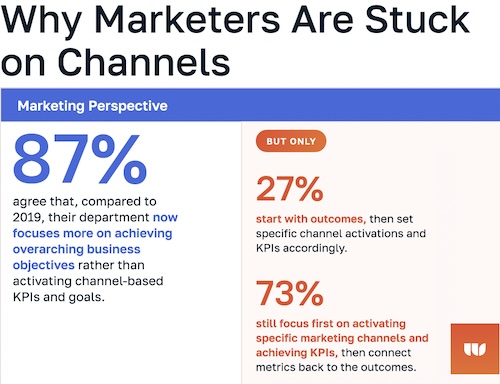
And while the importance of outcomes is generally acknowledged, the draw of focusing on channels remains strong. Only about a quarter (27 percent) of marketers say that they start out prioritizing outcomes before shifting their attention to specific channels and KPIs.
To get past this problem, Walker Sands suggests what they term “Outcome-based marketing.”
The study concludes that “with an understanding of the root problem—channel-first biases—we can start to kick less-than-efficient habits to the curb and make the shift toward an outcome-first mentality.”

 Consumers who once demanded convenience now require consistent, multi-channel experiences that cater to them at every point. Brands must have a clear, audience-appropriate, and channel-specific voice across all platforms.
 Employees at U.S. companies are experiencing high levels of burnout, but managers are lagging behind when it comes to their awareness of the problem
 Brand has a powerful effect on a company’s valuation, but the level of brand understanding in the investment community leaves a lot to be desired, according to a new study from Brodeur Partners, Interbrand and NewtonX.
 AI may still be viewed with a wary eye by most media pros, but its use is growing, according to a new study from Muck Rack.
 Thought leadership can make made B2B brands more "powerful and attractive to buyers," according to Edelman report.


 Have a comment? Send it to
No comments have been submitted for this story yet.