
 |
Edelman reports a slight uptick in people’s trust in business, NGOs, government and media, according to its 2019 Trust Barometer released today.
People though remain distrustful of government and media with each scoring 47 percent trust ratings, up three percent. They are more bullish on NGOs and business at 56 percent each.
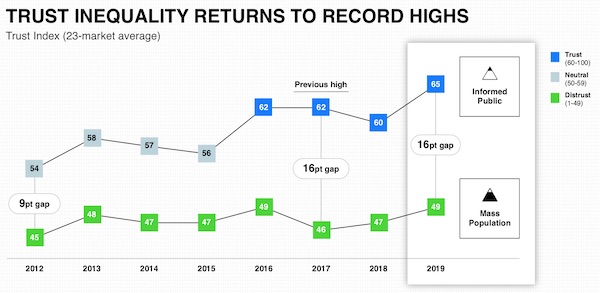
The firm finds a 16 percent trust gap between the “informed public” (65 percent) and the “mass population” (49 percent).
Trust among informed Americans jumped a healthy 15 points to 60 percent and six points to 49 percent for the general population.
Women are less trustful than men by a 50 percent to 55 percent margin. There's a double-digit gender trust gap of 15 percent in the US, driven by women’s lower trust in business.
The Trust Barometer shows a 38 point gap in trust in media between Democrats (69 percent) and Republicans (33 percent).
 Republicans, in turn, are more trustful of business by a 66 percent to 51 percent score.
The Barometer reports a 22 percent surge in news engagement among “consumers” (consume news weekly or more) and “amplifiers (consume news weekly or more and share or post content several times a month or more).
Sixty-five percent of Americans and Canadian trust traditional media, while little more than one-in-three (34 percent) trust social media.
About three-quarters (73 percent) of respondents overall worry about false information or fake news being used as a weapon.
"My employer" (75 percent) is the most trusted institution. That trust "cements the employer-employee relationship," according to the Barometer.
Nearly eight-in-ten (78 percent) of employees who trust their employer are more likely to advocate on its behalf. Only 39 percent of workers who did not trust their employer are willing to lobby for it.
That trust advantage is found in loyalty (38 percent), engagement (33 percent) and committment (31 percent), according to Edelman's 19th annual trust barometer.

 Consumers who once demanded convenience now require consistent, multi-channel experiences that cater to them at every point. Brands must have a clear, audience-appropriate, and channel-specific voice across all platforms.
 Employees at U.S. companies are experiencing high levels of burnout, but managers are lagging behind when it comes to their awareness of the problem
 Brand has a powerful effect on a company’s valuation, but the level of brand understanding in the investment community leaves a lot to be desired, according to a new study from Brodeur Partners, Interbrand and NewtonX.
 AI may still be viewed with a wary eye by most media pros, but its use is growing, according to a new study from Muck Rack.
 A new study from Walker Sands says that some marketers have been putting the cart before the horse when it comes to the relationship between marketing channels and business outcomes.

 Have a comment? Send it to
No comments have been submitted for this story yet.