
 |
While most companies conduct detailed searches when they’re looking to hire a senior communications executive, they often don’t go into as much detail when it comes to shopping for a new agency, according to a study published this week by the Institute for Public Relations.
"Few organizations use a comprehensive search process or search tools and consultants for agencies, which would be standard practice for individual hires,” said Steven Drake, principal of RFP Associates, which produced the report along with CommunicationsMatch and Researchscape International.
Less than 15 percent of the communications executives surveyed for the study said that they consulted such sources as trade media, online search engines, agency search platforms, professional societies or agency search consultants to help them find an agency.
About three-quarters of them said they rely on their own knowledge, and 67 percent said word of mouth and the advice of peers were key factors that helped them in their search.
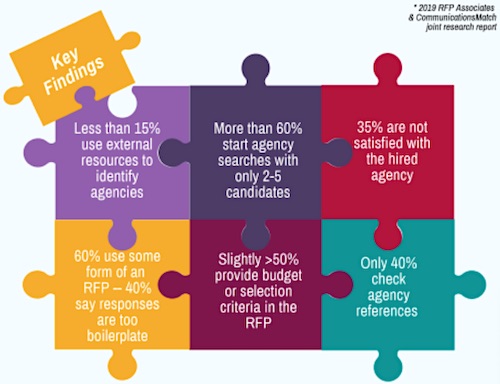 |
That lack of reliance on standard research tools often leads to a small pool of candidates from which new agencies are selected. 64 percent of the survey’s respondents said they usually identified only between two and five agency candidates during a selection process, while the report says that expanding that pool would likely result in a more successful choice.
The survey also finds that RFPs are often incomplete and do not provide all the information agencies need to respond. More than half (54 percent) of respondents said their RFPs do not include a budget.
And although most companies surveyed say they are satisfied with the primary agency they have chosen, it also found that they often don’t stay with one agency for all that long before they start the search process again. Only about 30 percent of primary agency relationships have lasted four years or more, while over 40 percent have lasted two years or less.
The study’s authors say that a lack of rigor in the process used to hire agencies is at least partly at fault for these short tenures. “When shortcuts are taken in the hiring process,” they write, “client and agency expectations may not be aligned, requiring work by both parties once the relationship has been established to get on the same page.”
Surprisingly, the lowest levels of satisfaction were with the agencies that are being paid the most. Agencies working with budgets of $1 million or more got considerably lower marks from their clients than did agencies working with smaller budgets.
But the main takeaway of the study remains that companies could benefit from taking more time to get the whole story about agencies that they are considering.
“Best practices include conducting a comprehensive search to identify qualified agencies and the allocation of internal resources or use of external agency search consultants,” the study concludes.

 Consumers who once demanded convenience now require consistent, multi-channel experiences that cater to them at every point. Brands must have a clear, audience-appropriate, and channel-specific voice across all platforms.
 Employees at U.S. companies are experiencing high levels of burnout, but managers are lagging behind when it comes to their awareness of the problem
 Brand has a powerful effect on a company’s valuation, but the level of brand understanding in the investment community leaves a lot to be desired, according to a new study from Brodeur Partners, Interbrand and NewtonX.
 AI may still be viewed with a wary eye by most media pros, but its use is growing, according to a new study from Muck Rack.
 A new study from Walker Sands says that some marketers have been putting the cart before the horse when it comes to the relationship between marketing channels and business outcomes.


 Have a comment? Send it to
No comments have been submitted for this story yet.