
Businesses are increasingly being called upon to fill in the gap created by falling levels of trust in government institutions, according to a new study released by Weber Shandwick, United Minds and KRC Research.
“The Workplace as a New Town Square” finds that employers are taking a major role in ensuring the health and safety of their employees during the pandemic, as well as making progress on racial inequality. It also finds that many people think government, at both the state and federal level, is coming up short.
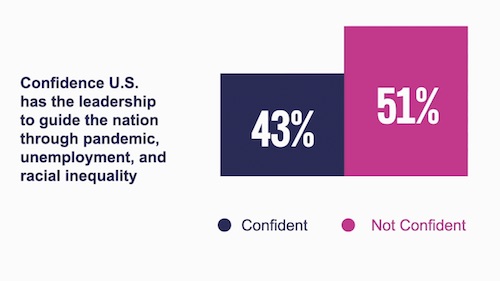 |
Only 43 percent of those surveyed said that they were confident that the U.S. has the leadership to guide the nation through the hurdles presented by COVID-19, rising unemployment and systemic racism.
When it comes to COVID-19, confidence that the federal government is taking the right steps to stop the virus’s spread and bring it under control slid from 58 percent of those surveyed from April 15-17 to 46 percent for those polled from June 15-17. State governments did better, but their trust level still dropped from 69 percent in April to 53 percent in June.
Employers got higher scores. In June, 72 percent of employees surveyed said that their employer’s response to the coronavirus is exactly what it should be, with 69 percent agreeing that their employer is putting worker safety above profit.
In addition, most workers said their employers were adequately addressing racial inequality in the workplace, with 78 percent indicating that their employer does not tolerate discrimination of any kind at work and 74 percent agreeing that their employer has created a fair work environment where they can be themselves and contribute to the company.
However, there was a sizeable gap between how black and white workers view discrimination in the workplace. While 80 percent of white employees said that discrimination was not tolerated in their workplace, that number drops to 64 percent for black employees.
The increased trust in businesses creates a window of opportunity, the report says. One of the main tools to capitalize on that is to put communications front and center. Companies that communicate with employees and consumers can see a noticeable uptick in their reputation for trustworthiness.
For example, 88 percent of workers who said their employers have communicated about recent crises said they were proud to work for that employer. For those who did not receive such communications, that number drops to 51 percent.
As regards what issues companies should communicate about, the top issue is expressing zero tolerance for discrimination and harassment (46 percent), followed by pledging to fight racism, discrimination and unconscious bias (44 percent), and committing to pay equity (44 percent).
“The Workplace as a New Town Square,” part of continuing series of surveys, polled 1,004 adults between June 15-17. To see the report, click here.

 Consumers who once demanded convenience now require consistent, multi-channel experiences that cater to them at every point. Brands must have a clear, audience-appropriate, and channel-specific voice across all platforms.
 Employees at U.S. companies are experiencing high levels of burnout, but managers are lagging behind when it comes to their awareness of the problem
 Brand has a powerful effect on a company’s valuation, but the level of brand understanding in the investment community leaves a lot to be desired, according to a new study from Brodeur Partners, Interbrand and NewtonX.
 AI may still be viewed with a wary eye by most media pros, but its use is growing, according to a new study from Muck Rack.
 A new study from Walker Sands says that some marketers have been putting the cart before the horse when it comes to the relationship between marketing channels and business outcomes.


 Have a comment? Send it to
No comments have been submitted for this story yet.