
The COVID-19 pandemic roiled the marketing and communications world, with more than three-quarters of North American PR agencies reporting a net decrease in fees this year or no growth at all, according to an industry survey conducted by PR merger and acquisition consultancy Gould+Partners.
The Gould+Partners survey polled more than four-dozen PR agencies on their 2019 actual net revenues (fees plus mark-ups) as well as their estimated 2020 net revenues and planned 2021 fee revenues.
The survey found that more than half (56 percent) of PR firms reported a decrease in net revenues this year. An additional 21 percent showed flat or zero growth in 2020. Overall, less than a quarter (23 percent) of the firms participating in the survey reported any growth in 2020.
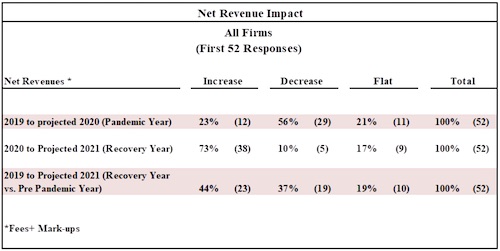 |
Tracking agencies’ 2019 actual net revenues against their 2020 projected fee revenue revealed a net decrease of six percent, according to the survey, the first such year-over-year loss recorded by Gould+Partners’ annual survey in the last seven years.
But not all the news is bad. Gould+Partners managing partner Rick Gould told O’Dwyer’s that the industry’s average six-percent dip in growth this year was actually less than initially expected. Moreover, the survey also shows that nearly three-quarters of firms (73 percent) anticipate a rebound in 2021. More than half of that number (44 percent) even expect next year to yield higher net revenues for their agencies than 2019.
According to Gould, growth in the PR industry had, until COVID hit, been on a steady keel, peaking at nearly 10 percent (9.8 percent) in 2013, and revealing consecutive year-over-year gains between 4.8 percent and 7.8 percent each year for the following six years.
Barring 2020’s decline, the Gould+Partners survey now projects a year-over-year industry net growth of 5.6 percent in 2021, which accounts for a net decrease of only 0.8 percent from pre-pandemic 2019.
“What I am finding most encouraging is that 44 percent of the firms projected an increase in net revenues in 2021 over the robust year we had in 2019,” Gould told O’Dwyer’s. “I attribute this to the most successful firms making an increased effort to expand their pipeline, to go after new business as well as creating new billable services organically. That is a huge turnaround from 77 percent of the firms showing either a decrease in their fees in 2020 or a no growth/flat fee level.”
“It is indicative of the natural optimism and confidence that most PR firm owners have as a mindset,” Gould continued. “They got blindsided by the pandemic in 2020 and will come back rebuilding, recovering and prospering by the end of 2021.”
Gould+Partners’ “New Revenue Spot Survey” was based on responses from 52 PR agencies located in ten regions across North America. The survey was conducted in November.

 DJE Holdings, parent of Edelman and Zeno, launches RUTH as an independent shop named after Ruth Edelman, mental health advocate, wife and longtime business partner of Dan Edelman.
 New York City PR firms make up the largest slice of O'Dwyer's 147 firm overall ranking with 33 of 40 in the New York/New Jersey area either calling Manhattan their home or having a presence there.
 Subject Matter+Kivvit, which joined forces in May, has rebranded as Avoq, an integrated shop with more than 200 professionals in Washington, New York, Asbury Park (NJ), Miami and Chicago.
 While PR pros stationed at in-house comms. teams and those working for agencies share many of the same objectives, they also have markedly different top priorities, according to a recent report.
 Edelman is cutting 240 employees or about four percent of its workforce to cope with the cooling down of the PR sector, according to a memo from CEO Richard Edelman.

 Have a comment? Send it to
No comments have been submitted for this story yet.