
Almost nine out of 10 marketing execs say their companies plan to increase marketing spend in 2022, according to a new survey from 360PR+ and Engine Group.
Only two percent say they aren’t planning to up their marketing spend, with 10 percent saying that it’s too early to make a prediction.
A large majority of those surveyed said that they have gotten better at their jobs in response to the demands posed by the pandemic. The biggest lesson they’ve learned: how to prioritize. More than three-quarters (76 percent) said the pandemic has helped them get more focused and better prioritize their objectives.
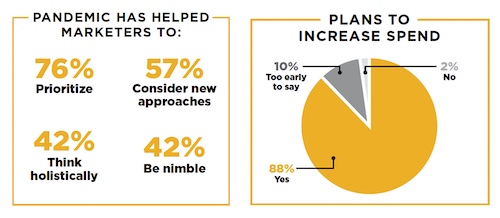 |
More than half (57 percent) said they have become more open to new approaches, 47 percent said they are more likely to think holistically, and 42 percent thought they had become more nimble.
There was general agreement (94 percent) that brand marketing and corporate reputation are becoming more closely tied together. Respondents also saw corporate leadership as being a bigger part of the storytelling process, with 68 percent saying that they plan to increase the use of senior executives in brand communications and 95 percent recognizing the importance of such execs as the CEO or president being effective storytellers.
With an eye toward a lessening of the pandemic’s effects, more than half (54 percent) said they plan to hold more in-person events in 2022. But virtual events are far from disappearing, with 44 percent noting that they will schedule more of them.
For the report, 360PR+ surveyed 200 marketing and communications leaders across the US during Summer 2021.

 Consumers who once demanded convenience now require consistent, multi-channel experiences that cater to them at every point. Brands must have a clear, audience-appropriate, and channel-specific voice across all platforms.
 Employees at U.S. companies are experiencing high levels of burnout, but managers are lagging behind when it comes to their awareness of the problem
 Brand has a powerful effect on a company’s valuation, but the level of brand understanding in the investment community leaves a lot to be desired, according to a new study from Brodeur Partners, Interbrand and NewtonX.
 AI may still be viewed with a wary eye by most media pros, but its use is growing, according to a new study from Muck Rack.
 A new study from Walker Sands says that some marketers have been putting the cart before the horse when it comes to the relationship between marketing channels and business outcomes.


 Have a comment? Send it to
Oct. 1, 2021, by Joe Honick
This is an important review and report well presented but urgently calling for what I boringly refer to as the "therefore" that should follow presentation of reasonably reliable data. Now that we know what we know, how do we decipher what it all means for what should be done next and why? I like getting paid for those answers.