
 |
While consumer expectations for a brand’s sense of a purpose are climbing, many brands are dropping the ball when it comes to meeting those expectations.
That’s the finding of the latest Purpose Priorities Report from Porter Novelli. The annual report, which measures the “purpose credibility” that audiences place in brands, shows a drop from 6.89 (out of 10) in 2018 to 6.02 in this year’s survey.
That drop indicates what the study’s authors say is a need for brands to “do more than make promises or try to address Purpose via a one-off campaign.”
A large majority (84 percent) of the 7,000 adults who were surveyed for the study would agree with that, saying that they think “companies should demonstrate how they are following through on their promises to people, the planet and society.”
Perhaps the most important issue on which audiences want to see a real sense of commitment is the environment. Almost eight out of ten respondents (78 percent) think that companies should have a point of view on environmental sustainability.
 |
In addition, a company’s environmental stance can be a key driver of purchase decisions. Over a third (35 percent) of those surveyed indicated that they would start or increase purchasing from a company if it shared their view on environmental issues.
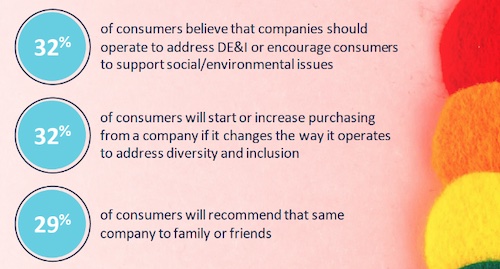
The weight of DE&I issues when it comes to purchasing decisions is considerable as well. More than three in 10 respondents (32 percent) would be more likely to purchase from a company if it changed the way it operates in an effort to address diversity and inclusion, with 29 percent adding that they would also be more likely to recommend that company to family or friends.
Treading into political waters comes with its risks, however. Almost half of respondents (48 percent) said they would stop or reduce their purchases from a company if donated to a party or candidate whose views of political issues differ from their own. Nearly as many (44 percent) would cut back on their purchases from a company that made comments they disagreed with on a political issue.
Some companies are doing considerably more than others in the credibility department, however. According to Porter Novelli’s Better Business Matrix, which measures the reputation of companies regarding their commitment to “people, planet and society,” Toyota topped the list in the automotive sector. Top performers in other sectors included PepsiCo (food & beverage), Intel (technology), TIAA (financial services), T-Mobile (communications) and REI (retail).
The Purpose Priorities Report was fielded by marketing data & analytics company Dynata.

 Consumers who once demanded convenience now require consistent, multi-channel experiences that cater to them at every point. Brands must have a clear, audience-appropriate, and channel-specific voice across all platforms.
 Employees at U.S. companies are experiencing high levels of burnout, but managers are lagging behind when it comes to their awareness of the problem
 Brand has a powerful effect on a company’s valuation, but the level of brand understanding in the investment community leaves a lot to be desired, according to a new study from Brodeur Partners, Interbrand and NewtonX.
 AI may still be viewed with a wary eye by most media pros, but its use is growing, according to a new study from Muck Rack.
 A new study from Walker Sands says that some marketers have been putting the cart before the horse when it comes to the relationship between marketing channels and business outcomes.

 Have a comment? Send it to
No comments have been submitted for this story yet.