
 |
The worldwide economic slowdown appears to have led many organizations to cut back on their use of digital tools, content and infrastructure, as well as lessening their emphasis on corporate social responsibility and ESG projects, according to a new study from Team Lewis.
The agency’s “Global Marketing Engagement Index 2022” says that companies are becoming more cautious and risk-averse as they face the threat of economic headwinds. The study used Lewis’s Marketing Engagement Tracker to examine the top 300 companies from the Forbes Global 2000 list in areas including CSR/ESG, digital marketing, media and site security.
It found that companies are scaling down in several key areas of their online communications. The biggest drop was in the emphasis given to media content on company websites—an area that includes case studies, product or service news, or leadership interviews or quotes. While the overall score for companies in that area in 2021’s survey was 56 percent, it dropped to 35 percent this year.
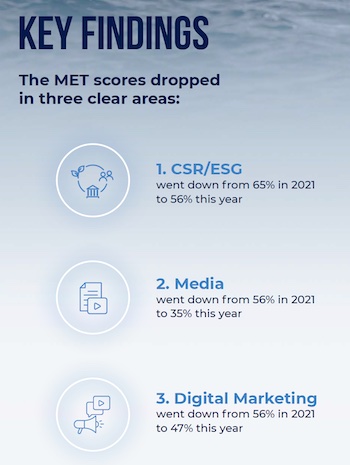 |
The presence of CSR/ESG initiatives on company websites was also down, going from a 65 percent rating last year to 56 percent this year.
A smaller degree of emphasis is also being given to basic digital marketing concerns (bounce rate, domain authority, search engine optimization, etc.), which went from 56 percent in 2021 to 47 percent this year.
MET scores were not down in all areas, however. The focus on user experience took a jump from 35 percent last year to 61 percent this year. The study attributes much of that rise to “basic improvements in options to change languages and by the ADA (Americans with Disabilities Act) being more widely followed.”
Social presence (the presence of a company or its CEO on social media or channels) was also a bigger focus, rising from a 55 percent score in 2021 to 62 percent). However, the study also noted that 77 percent of the CEOs from the surveyed companies are still not on social media.
The Marketing Engagement Index also names what it calls “the Most Engaging Brands in the World.” Globally, the top company was Microsoft, followed by TD Bank, abbvie and General Motors. Microsoft also took the top spot in the US. In EMEA, Schneider Electric, L’Oréal and Unilever racked up the highest MET scores, and DBS Bank Limited led the way in APAC, followed by Toyota, Kia and Sony.

 Consumers who once demanded convenience now require consistent, multi-channel experiences that cater to them at every point. Brands must have a clear, audience-appropriate, and channel-specific voice across all platforms.
 Employees at U.S. companies are experiencing high levels of burnout, but managers are lagging behind when it comes to their awareness of the problem
 Brand has a powerful effect on a company’s valuation, but the level of brand understanding in the investment community leaves a lot to be desired, according to a new study from Brodeur Partners, Interbrand and NewtonX.
 AI may still be viewed with a wary eye by most media pros, but its use is growing, according to a new study from Muck Rack.
 A new study from Walker Sands says that some marketers have been putting the cart before the horse when it comes to the relationship between marketing channels and business outcomes.

 Have a comment? Send it to
No comments have been submitted for this story yet.